Diploma in Wealth Management in India: Eligibility, Curriculum, Career Paths and How to Choose?
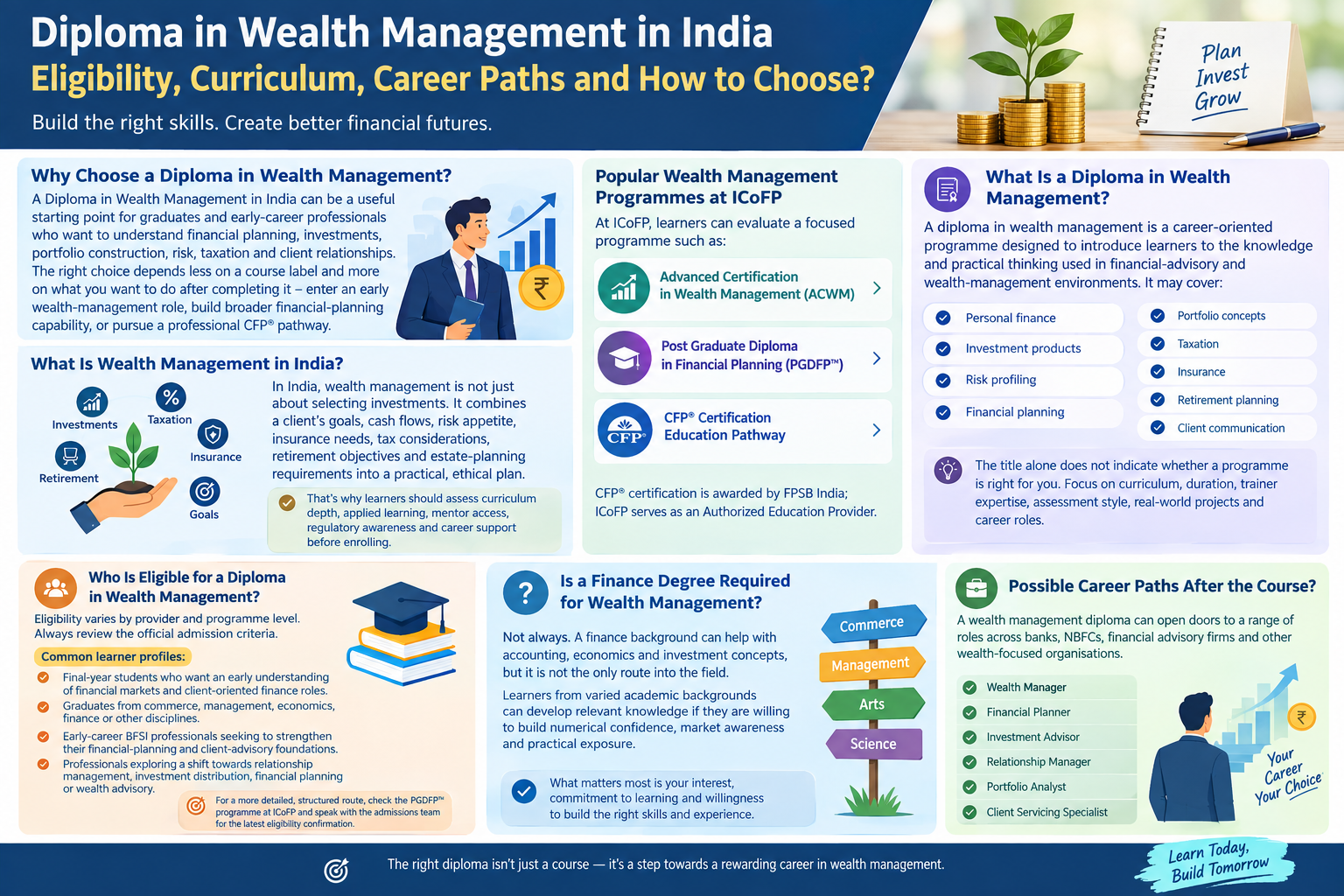
A Diploma in Wealth Management in India can be a useful starting point for graduates and early-career professionals who want to understand financial planning, investments, portfolio construction, risk, taxation and client relationships. The right choice depends less on a course label and more on what you want to do after completing it: enter an early wealth-management role, build broader financial-planning capability, or pursue a professional CFP® pathway.
In India, wealth management is not just about selecting investments. It combines a client’s goals, cash flows, risk appetite, insurance needs, tax considerations, retirement objectives and estate-planning requirements into a practical, ethical plan. That is why learners should assess curriculum depth, applied learning, mentor access, regulatory awareness and career support before enrolling.
At ICoFP, learners exploring wealth-management careers can evaluate a focused programme such as the Advanced Certification in Wealth Management (ACWM), a broader Post Graduate Diploma in Financial Planning (PGDFP™), or the CFP® certification education pathway. CFP® certification itself is awarded by FPSB India; ICoFP serves as an Authorized Education Provider.
What Is a Diploma in Wealth Management in India?
A diploma in wealth management is a career-oriented programme designed to introduce learners to the knowledge and practical thinking used in financial-advisory and wealth-management environments. Depending on the provider, it may cover personal finance, investment products, risk profiling, financial planning, portfolio concepts, taxation, insurance, retirement planning and client communication.
The title alone does not indicate whether a programme is right for you. Two courses with similar names may differ significantly in academic entry requirements, duration, trainer expertise, assessment style, real-world projects and the career roles they prepare learners to explore.
A strong programme should help a learner move from theory to application. For example, rather than merely defining asset allocation, it should show how an adviser considers a client’s time horizon, income stability, goals, liquidity needs and willingness to take risk before proposing an appropriate investment approach.
Who Is Eligible for a Diploma in Wealth Management in India?
Eligibility varies by provider and programme level. Before applying, always review the official admission criteria for the exact course you are considering.
Common learner profiles include:
Final-year students who want an early understanding of financial markets and client-oriented finance roles.
Graduates from commerce, management, economics, finance or other disciplines who want to develop wealth-management knowledge.
Early-career BFSI professionals seeking to strengthen their financial-planning and client-advisory foundations.
Professionals exploring a shift towards relationship management, investment distribution, financial planning or wealth advisory.
For a more detailed, structured route, the PGDFP™ programme at ICoFP is designed for candidates who meet its published entry criteria. Candidates should refer to the official programme page and speak with the admissions team for the latest eligibility confirmation.
Is a Finance Degree Required for Wealth Management?
Not always. A finance background can help with accounting, economics and investment concepts, but it is not the only route into the field. Learners from varied academic backgrounds can develop relevant knowledge if they are willing to build numerical confidence, market awareness, communication skills and ethical client-centred judgement.
However, wealth management is a high-trust profession. The more complex the role you target, the more important it becomes to pursue credible education, understand relevant regulatory requirements and demonstrate practical capability.
What Does a Wealth Management Curriculum Include?
A useful wealth management curriculum should explain how financial decisions connect instead of treating investments, insurance, tax and retirement as isolated topics. The following are core learning areas to look for.
Financial Planning Fundamentals
This area introduces goal setting, budgeting, cash-flow analysis, emergency planning and the financial-planning process. Learners should understand how an adviser gathers information and identifies priorities before discussing products or investment strategies.
Investment and Portfolio Concepts
A learner should develop a foundation in asset classes, return and risk, diversification, mutual funds, fixed-income instruments, equity concepts and portfolio construction. The purpose is not to predict markets, but to understand why a client’s objectives and risk profile influence investment choices.
Risk Management and Insurance Planning
Wealth-management conversations often include protection needs. A curriculum should cover the role of risk assessment, life and health insurance concepts, contingency planning and the relationship between protection and long-term wealth creation.
Tax, Retirement and Estate-Planning Awareness
Tax and succession considerations can affect financial decisions. Programmes should introduce the role of tax-aware planning, retirement needs, nomination, estate-planning concepts and the need to seek appropriately qualified advice where required.
Client Engagement and Communication
Technical knowledge alone is insufficient. A wealth professional must explain financial choices clearly, ask appropriate questions, document needs and communicate in a manner that respects client goals and suitability.
Ethics, Suitability and Regulatory Awareness
A responsible curriculum should cover ethical conduct, disclosure, client suitability and the importance of operating within applicable regulations. Learners should understand that a course does not automatically authorise a person to provide regulated advice or perform regulated activities.
For learners looking for a focused wealth-management foundation, explore ICoFP’s Advanced Certification in Wealth Management. For a wider financial-planning pathway that includes wealth-management learning, review the PGDFP™ programme.
What Career Paths Can a Wealth Management Diploma Support?
A Diploma in Wealth Management in India may support foundational preparation for a range of client-facing and finance-related roles. Job availability, hiring criteria and career progression vary by employer, location, prior experience, qualifications and individual performance.
Possible career directions include:
Wealth-management associate
Relationship-management trainee
Client-service executive in BFSI
Investment-products support executive
Financial-planning support associate
Mutual-fund or insurance distribution support roles, subject to applicable requirements
Private-banking operations or client-support roles
Financial-services business-development roles
A learner should view the diploma as one component of career preparation. Employers also value communication, spreadsheet capability, market awareness, professionalism, client empathy and the ability to learn continuously.
What Does a Wealth Manager Do?
A wealth manager or wealth-advisory professional typically helps clients understand their financial goals and coordinates relevant financial-planning conversations. Depending on the role, organisation and regulatory permissions, the work may involve gathering client information, discussing goals, supporting portfolio reviews, coordinating product documentation, explaining financial concepts and maintaining client relationships.
At a more advanced level, wealth professionals may work with clients on integrated questions involving investments, risk management, retirement, tax considerations and intergenerational wealth planning. The exact scope of activity depends on the employer, the individual’s qualifications and applicable regulations.
How Should You Choose a Diploma in Wealth Management?
Use this checklist rather than relying solely on a course name, fee or marketing promise.
1. Start With Your Career Goal
Ask yourself: do you want an entry-level foundation, a broader financial-planning qualification or a professional certification pathway? A focused course can be suitable for early career readiness, while a broader programme may suit learners seeking deeper, more integrated capability.
2. Review the Curriculum in Detail
Look for a published module structure. Confirm whether it covers financial planning, investments, risk, retirement, taxation, client engagement and ethics. A one-dimensional investment-only course may not meet the needs of someone aiming for holistic wealth-management work.
3. Check for Applied Learning
Ask whether you will work through case studies, client-profiling exercises, financial-planning scenarios, portfolio discussions or assessment-based projects. Applied practice helps turn concepts into clearer professional judgement.
4. Verify Faculty and Institutional Credibility
Review instructor credentials, industry experience and the institution’s track record in financial education. Learners should also check whether claims about affiliations, certifications and outcomes are clearly stated and verifiable.
5. Understand the Certification Pathway
If your long-term goal is comprehensive financial planning, learn how a programme connects with recognised professional education routes. For candidates evaluating the CFP® route, see ICoFP’s CFP® certification education page. ICoFP provides education for the pathway as an Authorized Education Provider; FPSB India awards the CFP® certification to candidates who fulfil its applicable requirements.
6. Evaluate Career Support Realistically
Ask what career support means in practice. Look for guidance on interview preparation, employability skills, employer engagement and role awareness. At ICoFP, the correct statement is 100% placement support, not a placement guarantee.
7. Confirm Admission, Delivery and Assessment Details
Before enrolling, verify the latest eligibility, class schedule, mode of learning, attendance expectations, assessment pattern, programme duration and any external examination requirements directly with the provider.
Diploma in Wealth Management vs PGDFP™ vs CFP® Pathway
These options can serve different learner needs. The best choice depends on your starting point and intended career direction.
Consideration | Diploma in Wealth Management | PGDFP™ | CFP® Pathway |
Typical purpose | Builds a focused introduction to wealth-management concepts | Develops broader financial-planning knowledge with wealth-management relevance | Builds toward a professional financial-planning certification route |
Best suited to | Learners seeking an early wealth-management foundation | Graduates seeking a deeper, career-focused financial-planning route | CFP® aspirants who meet the applicable pathway requirements |
Learning breadth | Varies widely by provider | Broader financial-planning orientation | Structured around CFP® education and FPSB India requirements |
What to verify | Modules, faculty, applied learning and role relevance | Current admissions criteria, curriculum and programme details | Eligibility, examinations, experience and ethics requirements set by FPSB India |
ICoFP option to explore |
The table is a decision aid, not a claim that all diplomas are equivalent or that any programme guarantees a role. Review the official information for each option before making an enrolment decision.
Which ICoFP Pathway May Fit Your Goal?
Choose ACWM If You Want a Focused Wealth-Management Starting Point
The Advanced Certification in Wealth Management may be relevant for students and graduates who want to begin developing practical knowledge of portfolio construction, financial planning and risk analysis for early wealth-management and relationship-driven finance roles.
Consider PGDFP™ If You Want Broader Financial-Planning Depth
The Post Graduate Diploma in Financial Planning (PGDFP™) may be appropriate for graduates seeking a longer, more structured route that connects financial planning, wealth management and related professional preparation. Review the official programme page for current academic details and admissions requirements.
Explore the CFP® Pathway If Your Target Is Professional Financial Planning
The CFP® certification education pathway is relevant for learners who want to work toward an internationally recognised professional financial-planning credential. Candidates should understand that the CFP® certification is awarded by FPSB India when applicable education, examination, experience and ethics requirements are met.
If you already hold relevant qualifications and work experience, see whether the CFP® Fast Track pathway is suitable for your profile. Eligibility should always be confirmed from the current official programme information.
How Can You Prepare for a Wealth Management Career Before Enrolling?
You can begin building a stronger foundation now.
Follow major financial and economic developments from reliable sources.
Learn the basics of personal budgeting, compounding, risk and diversification.
Practise explaining one finance concept in plain language to a non-finance audience.
Build spreadsheet fluency for simple cash-flow and goal-planning exercises.
Read the official programme curriculum carefully before deciding.
Use professional networking conversations to understand entry-level BFSI and advisory roles.
Choose education that treats ethics, suitability and client trust as central to the profession.
FAQs
Make an Informed Course Decision
The best Diploma in Wealth Management in India is the one that gives you relevant skills for your intended role and a credible next step in your professional journey. Compare the course curriculum, practical learning, institutional expertise, career support and long-term pathway before you enrol.
To explore ICoFP’s wealth-management and financial-planning learning options, review the Advanced Certification in Wealth Management, PGDFP™, CFP® certification education pathway and CFP® Fast Track. For current eligibility, admissions, delivery format and programme information, contact the ICoFP admissions team.