
How to build Core and Satellite portfolio using MF Schemes

As geopolitical tensions are rising globally, financial planners recommend their clients to build a Core and Satellite portfolio using mutual fund schemes to optimise their long-term returns and meet their financial goals.

Let us understand Core and Satellite Portfolio in the accumulation stage

Core Portfolio using MF schemes:

The core portfolio is built based on the investor’s objectives—age, risk-taking capacity, and the time available (Time Horizon of investments) to reach their financial goals. It is called long term asset mix as well as strategic asset allocation

Investors can have a mix of low cost index funds and diversified large-cap-oriented equity funds that aim to provide stability and help achieve long-term goals. Large-cap stocks have proven track records and strong management teams with the ability to manage difficult domestic or global situations. To build the core equity portfolio, investors can use a mix of large cap schemes/Funds and Index funds. They can also invest in Flexi cap and Multi cap funds with proven track record and consistent returns as desired by investors.


Satellite Portfolio using MF schemes:
The satellite portfolio also called Tactical Asset allocation can be made based on relatively aggressive schemes /funds such as small-cap funds, momentum funds, value funds, or narrow Sectoral funds like defence, infrastructure, banking, IT, and pharma. These carry a higher risk but have the potential to generate higher alpha.

Core vs Satellite- How much to be in each strategy?

Based on an investor’s risk profile and timeframe for goals, financial planners believe investors can allocate a large amount 70–75% to their core portfolio, and the balance 25–30% to the satellite portion. While the core portfolio can remain stable and would not require high churning or frequent changes, the satellite portion may require investors to time the market to enter and exit at right time to generate maximum returns. Such schemes could carry higher risk and volatility

Now, it’s well known that equity has the best return potential, and if you are in the accumulation phase, it has a crucial role in your portfolio.

This does not mean that debt funds or hybrid funds can’t be core funds. A debt fund can be a core fund in a retiree’s portfolio. And if someone is looking for automatic asset allocation, even a hybrid fund can be a core fund.

The core funds take care of the returns and the stability, and the satellite funds help boost the overall returns or help diversify better

Dean Madhu Shina

The SpeculativeTurn: Why India’s Gold Rush in 2026 Needs Advisory Leadership

January 2026 gave us a behavioural signal that we should not ignore.

For the first time in recent years, inflows into Precious Metal ETFs, particularly gold and silver, exceeded total inflows into equity mutual funds. In a country that has spent the last decade building SIP discipline and deepening financialisation, this is not a small shift. It reflects a change in investor sentiment.

Let us address the obvious question upfront. Yes, gold has delivered strong returns over the past decade. In several phases, it has outperformed equities. So why argue that it should remain a stabiliser and not become a dominant allocation?

Because performance does not define role.

Gold can perform exceptionally well during inflationary cycles, currency depreciation or global uncertainty. But economically, it does not represent ownership in productive enterprise. It does not grow earnings. It does not create innovation. It does not compound through business expansion. Its primary function in a portfolio is preservation and diversification.

There is nothing wrong with owning gold. The concern begins when allocation turns into migration.

If gold was part of a 5 to 10 percent allocation framework, that is strategic. If investors are increasing exposure because it has recently performed well, that is behavioural.

We must be honest here. A large section of retail investors today operate without a documented investment philosophy. DIY platforms have expanded access to markets, which is positive. But access without structure often leads to momentum chasing. When equity markets consolidate or move sideways, frustration sets in. Investors who entered during a strong rally expect linear returns. When that does not happen, capital shifts toward whatever is currently shining.

This is pendulum investing. And pendulum investing weakens compounding.

Equities represent participation in economic growth. Over long horizons, they align with productivity, profits and expansion. Gold protects. It hedges. It stabilises. Both are important. But confusing protection with growth distorts long-term wealth creation.

The January 2026 data should therefore not be celebrated as a metals victory. It should be seen as a behavioural checkpoint.

At this stage, the responsibility rests with the broader Financial Advisory community in India, including investment advisors, distributors, wealth managers and the 3,500 plus Certified Financial Planner professionals who are trained in structured, goal-based frameworks.

The role of an advisor today is not simply to recommend products. It is to protect investors from their own behavioural impulses.

Three reminders are critical.

  1. Asset allocation is not seasonal. It does not change because headlines change.
  2. Volatility is not failure. Consolidation phases are part of market structure.
  3. Goals drive allocation. Not recent returns.

If an investor’s retirement and education planning was built on long-term compounding assumptions, that logic does not collapse because gold outperformed for a few quarters.

India’s journey toward financial maturity depends not just on product innovation but on behavioural evolution. Precious metals have a legitimate place. Equities have a critical role. The discipline lies in keeping both in proportion.

Investing is not about chasing what worked last quarter.
It is about staying committed to what works over decades.

The advisory fraternity must lead that conversation firmly and responsibly.

Rishi Pal Singh Narang, CFP®
Academic Head
International College of Financial Planning

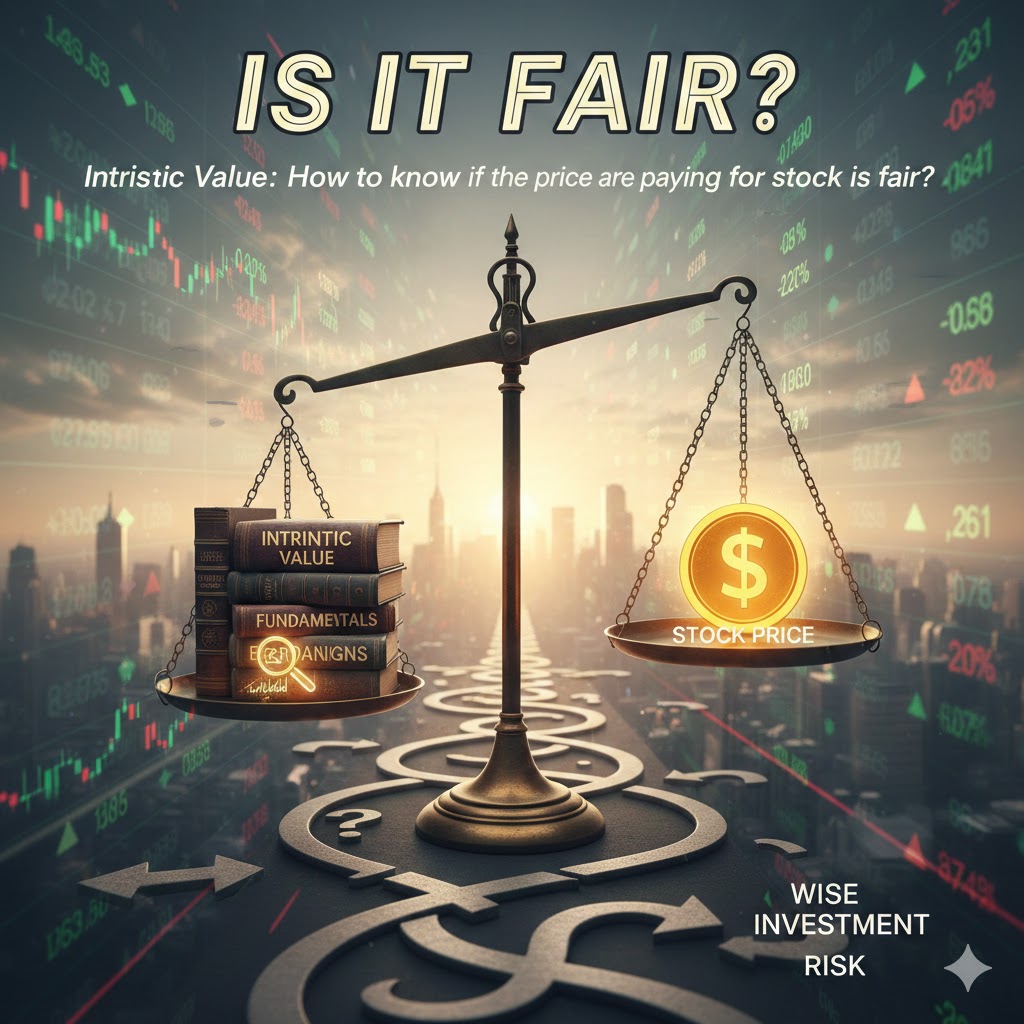
Intrinsic value: How to know if the price you are paying for a stock is fair?

Understanding intrinsic value helps you avoid buying expensive stocks and buy fairly priced stocks

 “Price is what you pay, and value is what you get,” said Warren Buffett explaining the distinction between cost and true worth. In investing, it is commonly called intrinsic value. It is a re- minder that we should not equate an asset’s market price with its fair value called Intrinsic Value.

The gap between the asset’s market price and its intrinsic value indicates whether it is undervalued, fairly valued, or overvalued. If the market price is less than the intrinsic value, the asset is considered undervalued, whereas if the market price is more than the intrinsic value, the asset is said to be overvalued.

While price is objective and visible in the marketplace, value is subjective, formed by fundamentals such as earnings, cash flows and future growth expectations and assets. A stock trading at a seemingly high price can still be a worthwhile investment if its future earnings, growth potential and financial strength are high that justifies the cost. And, a low-priced stock may prove risky if the business is becoming weak.

Intrinsic Value Calculation:

Dividend Discount Model

This method values a company based on its ability to generate income. It is based on the time value of money—money today is worth more than the same amount in the future because it can earn returns.

For instance, Rs.100 today becomes Rs.108 in
a year at 8% interest with annual compounding. So Rs.108 next year is worth Rs.100 today. Conversely, Rs.100 receivable after a year has a present value of Rs.92.59

Intrinsic value is calculated as the pre sent value of expected future cash flows (In the form of Expected Dividends and Final Value on redemption) discounted at the investor’s required rate of return.
Key inputs required:

  • Stream of income (dividends or cash flows and final value on selling- FV)
  • Discount rate
  • Timing of cash flows
    Remember, unlike bonds with fixed payments, equity valuations are based on uncertain future earnings.

Equity valuation is highly sensitive to underlying assumptions. Even small changes in expected dividend growth, cash flows, or discount rate can produce substantial changes in results. The discount rate, representing the return investors demand, has a pronounced effect on intrinsic value. When the discount rate rises, often due to increased risk perceptions or higher interest rates, equity valuations decline. Conversely, a lower discount rate boosts valuations by increasing the present value of future cash flows.