How do I secure future financially?

You can be the “Future King.” Yes, you read it right here. Once, you have a proper mentorship that drives you towards a secure financial future; you are on the path to becoming a King of your dreams. It’s time to prove this point and get ready for the secured future by being unstoppable from now on. Do you have the organized plans and intentions that will lead to a sheltered and riskless future? Well, many of us plan, but only a few of us can turn away the doubt of the future. Here’s how you reach to a more secure and stable tomorrow:

  • Specify financial goals: We all have a secret life where we make goals. So, we need to plan our financial goals. Take absolute control over them and get ready for the financial brightness of the future.
  • Make sure your expense budget is not exceeding the saving budget: Start saving first from your annual income and make sure that you retain at least 10-12% of funds for the savings every year.
  • Value money: Start valuing the money you earn. Once you start it, you will be able to multiply it soon. Just like the pyramid keeps climbing high, start investing your money in short-term and long-term investment plans. You can also make investments in commodities and real-estate.
  • Plan your taxes wisely: Have you ever heard of ELSS? This is a systematic investment plan wherein your lock-in period is of 3 years, and the return comes from the equity markets. You can invest in ELSS if you don’t get any tax benefits from your employer.
  • Understand types of loans: If you have a habit of taking loans for a personal vacation or buying something luxurious for yourself, stop doing it immediately. Don’t fill your heads with so many loans offers because ultimately personal loans tire you always with their higher rate of interests. On the contrary, home loans are a good option because you are making an investment and you would surely receive something back in the long-run. Abandon taking personal loans in every manner whether they stand for a short-term, mid-term or long-term period.
  • Make an additional source of earning: Start embracing new work opportunities with open arms. If you are a graduate or a post-graduate, then you can go for some freelance working opportunities like teaching, writing, web development, doing research for others, opening up a small outlet where you can work during the weekends or in evenings. Don’t just settle for the average. Accept new work opportunities and start making fixed deposits or recurring deposits out of those funds.
  • The right insurance for the right time: Insurance is a promise of protection if you pay the premium. Make sure that you cover life and health insurance early in your life. In times of urgency, it will pay off all your expenses with no questions asked.

Keeping all the above points in place, you can plan and live a stable future. It may happen that tomorrow, there will be no secure island. So, try not to happen that. No guard is calling or protecting us through a whistle, so, we should make a tailored future now.

Benefits and Scope of Pursuing the MBA course in finance- MBA in finance scope

MBA in finance scope: The MBA with the specialty in the Finance is among on more vouched for the courses in the Management. With this Master in Business Administration graduates with the specialization in the finances are be welcomed in the banking industry and the corporate sectors with the open arms. The skill associated along with the master in business administration in the finance is the evaluation and the production of the biggest expected value on an asset. The MBA finance helps the organization to improve on the finance of company very efficiently. The Master in degree administration with finance professionals are unlike CA’s more into the management of field doing to study of the raising capital and their efficient utilization, investment strategies, and market economics.

MBA in finance scope

The MBA Finance provides a vast scope of the career that enhance and prospects when compared to other related accounting degrees, as much it covers the different aspects of managing finance and accounting like the securities, investments, banking and the risk management, and business. One of the important roles of the financial manager is overseen the financial reports that help to the company along with the decision making, strategic planning, business development and the alliance management.

The importance of the MBA Finance Courses

The Master in Degree administration is the two year of the degree program. In this field, you can select the one that on your interest and favorites specialization on out of finance, HR, marketing and operating, etc. If you are going to get admission in Master in degree administration, you have to finish the graduate degree with good and best percentage in any of the discipline. In this mba finance courses, the candidates are offered the skills and knowledge of at an analytical thinking, the concept of the managerial decision, continuous process, to maintain the balance between the risk and the profitability, centralized nature and the co-ordination process. The MBA course in finance is included along with corporate finance, costing, budgeting, investment and the securities, international fiancé, and the working capital of managements. These were the subject of MBA finance to prepare for the students to operate with any related financial organization.

In the two-year program, the full-time of MBA program that you would be get well equipped with the knowledge and the skill would be very necessary to know the fundamental features of the financial department of the concerned organization. The candidates who have to finish the B.Com in the qualifying exam; they must go through this field of accountancy, finance, and any other related fields. If you are completed the undergraduate degree in medical, art, science, and humanities, you can do this MBA finance courses. After completed the MBA finance degree, you can search for the job placement in the different area of the fields such as like the banks, financial institutions, colleges and the universities, financial consultancies, and several governments and the private companies and the firms. Taking about on the field of MBA in finance, it provides the core understanding of the financial concepts from the managerial perspective.

The Objectives and Importance of Financial Planning

Financial Planning is one of the most important exercises that businesses have to undertake to make good decisions and also keep business viable amidst competition. Businesses shouldn’t take decisions in dark and this is where they need a Certified Financial Planner to guide them through the decision making process. Here we take a look at the objectives and importance of financial planning in detail –

Objectives of Financial Planning
Here we look at some of the key objectives for a business when it undertakes financial planning –

  • Understanding capital requirement – Getting clear idea of the capital requirement for a planned expansion or acquiring a new business is very important. It depends on number of factors such as competition, market scenario, the assets a business has and its long term planning. A financial planner can dig deep into the book and other relevant data and ascertain short and long term capital requirements.
  • Capital structure planning – This is one of the most significant stages in financial planning where you will need to chalk out a well-defined capital structure where important decisions would need to be taken in terms of debt to equity ratio.
  • Framing policies – Financial policies are the bedrock of your investments and acquisitions. A financial planner would set policies with regards to your lending, borrowings and cash control both in the short as well as long term.
  • Resource utilization – The success of any business move rests on maximum utilization resources at hand. Your financial plan would determine the roadmap for getting best out of the resources and also earning highest return on investments.

Importance of Financial Planning
As we have discussed above financial planning involves determining the objectives, policies and budgeting both in the short and long term. Here’s why it is important for your business –

  • Avoiding debt trap – Debt trap can sound doomsday for any business. When it comes to expanding business it often seems good to raise funds but there are dangers of raising unnecessary capital instead of looking into a business’ own resources. Financial planning helps in avoiding debt traps.
  • Fluidity in Funding – As much as avoiding debt trap is important so is to ensure that your business doesn’t suffer a fund crunch. With proper financial planning, you can ensure there is a good balance between the outflow and inflow that doesn’t hurt your operations.
  • Long Term Goals – Every decision that a business takes with respect to investments or divestments should be aligned to the long term goals of the business. This is what financial planners determine during their research.
  • Mitigating Risks – Every business is exposed to several risks and financial planners would lay down policies and plans to mitigate these risks.

Get a Certified Financial Planner onboard and you will be able to align your business moves with the long term goals and objectives of your business.

Summary – In this write-up, we talk about the objectives and importance of financial planning and how Certified Financial Planners can help businesses.

The Advantages of Mutual Funds

If you haven’t lived under the rocks for many years you’d be aware of Mutual Funds. While you may not know the benefits of investments in mutual funds but you would have come across ad campaigns asking you to keep your money in Mutual Funds. They do have many advantages and here we shall look at some of the reasons of why you should start investing in mutual funds –

  • Investment in equity – You’d be aware of the fact that equity markets offer you high rate of return. But they also tend to be extremely volatile, and if you lack technical knowledge to choose the right stocks you are likely to suffer losses. Mutual funds are the safest and easiest ways to leverage the equity market without going into the nitty-gritty of stocks trading.
  • Diversification of investments –Investors need to diversify their capital allocation in the equity market. In pure equity mutual funds or those where equity is the major component your investments is spread across different stocks that cuts down your risks as compared to trading in a single stock. Depending on your choice you can opt for sectoral mutual funds or funds that invest in companies by their size.
  • Beyond equity – Mutual fund investment isn’t just about investing in equity funds. You have safer options such as liquid funds, debt funds or those that invest your capital in the money market or income instruments. By choosing different types of funds you will be able to meet your short and long terms investment goals.
  • Professional management – This is perhaps the biggest benefit of investing in mutual funds. You don’t need to keep track of the market as is the case with investing in the equity market and make daily buying and selling decisions. A professional fund manager would do this for you. All that you need to do is invest your capital when the markets are conducive and divest part of your investments when you can book substantial profit.
  • Slow and steady investment – SIP or systematic investment plans have become the most preferred route of investment into mutual funds. Here you invest into various funds in small installments thus spreading your risks. What this does is reduces the entry barrier in investing and lets your grow your wealth exponentially over time. To share an example a monthly investment of ₹500 per month for 30 years in equity mutual funds or ₹1.8 lakhs in total can turn into ₹33.2 lakhs considering 15% annual return which is standard average for such long term investments.

To sum up mutual funds are one of the best instruments of investments. In India popularity of mutual funds has grown in the recent years as people see higher returns compared on traditional options of investments. By choosing funds based on your investment capital, age and investment goals you will be able to generate healthy returns both in the short and long term.

Summary – In this write-up we look at some of the benefits of mutual fund investments and why you need to invest in these.

Equity Advisory

Stock market is a unique place. It has a huge potential for long term wealth creation, if the investor focuses on just a few but correct investment opportunities. And if they can manage to make investments in even a few multibagger ideas, they will be on their way to an extremely wealthy life. No doubt that multibagger stocks can be life-changers. Even if we talk about the average long-term returns, equity beats every other asset class by a large margin. Unfortunately, most people still lose a lot of their money in stocks.

Why

This is majorly because such investors allow short-term events to affect their decisions. They are mostly lured by short-term gains and become fearful due to short-term volatility. They keep speculating as to what will happen next. They pick wrong stocks that lead to large portfolio level losses and eventually, they start avoiding markets. But we cannot blame the markets for losses of such people. People make mistakes which could have been avoided easily had they got themselves the right guidance. And that is the whole problem of going in markets without the right equity investment advisor.

Problem in Investing without the Right Equity Advisor

In India, mostly people invest their money in stocks based on tips received from friends, relatives and ‘well-wishers’. But neither these people nor their ‘tip-sources’ have much expertise or time to correctly identify the fundamentals behind a stock. As a result, stocks invested on basis of tips ends up losing money for the investors. There is another problem to it in the markets – problem of plenty. There are more than 5,000 companies listed on Bombay Stock Exchange alone. So, it is not easy to find the good ones worth investing from so many of them. Problem of plenty is not restricted to the number of companies alone. There is a constant bombardment of news and information. But all information is not useful. Unfortunately, the investor who is on his own (without any market study) doesn’t know which piece of information to consider and which to ignore.

Role of Equity Advisor

Now Making Wealth through stock market is not just about picking the right stock.

It is also about deciding how much to invest in each stock position (asset allocation), knowing when to sell and managing various risks all the time. Buy-and-Forget works in theoretical world but not in real life. Real wealth creation happens when you are able to buy the right stock, book profits at the right time and are also able to remove the under performers at the required time. And a good stock advisor understands all of this. He will always remain invested in top companies to understand their quarterly results and earnings growth. Nobody can doubt the importance of high quality research when making direct investment in equities. So the investment research company or the advisor whose team has experience in all types of markets (bear, bull, flat) will be in a better position to help you take informed investment decisions. A good advisor will not promise you the sky. He will help you develop realistic expectations about the risks and rewards of each investment option. Most importantly, he will help you avoid the common pitfalls that are the cause of big losses for most investors who enter markets on their own.

• Temptation to believe that you can time the market successfully every time.
• The fear-driven urge to sell at a loss when stock prices are falling.
• The greed-driven desire to buy when stock prices are going up without any change in fundamentals.

But strangely in India, people don’t seem to recognize the importance of having a true guide on their side. They fail to understand that by paying a few thousands as fees to their advisors, they can avoid losses worth lacs due to their wrong actions. We believe that having a professional and honest equity investment advisor on your side can help you gain access to valuable insights into the factors that affect the economy, stock markets and ultimately the individual stocks in your stock portfolio.

If you analyze the financial lives of the ultra-rich, you will see that they all have access to good investment advisors. So there is no doubt that having a good advisor can work wonders for your wealth.

So think about it

Remember that it’s easier to say things than to do them. We all know the formula of becoming physically fit – eat healthy, eat less and exercise more. But it takes a gym instructor to get our bodies back in shape. The same goes for investing in stocks. So find your true investment advisor at the earliest.


Hemant Parmar

MBA-FP (2017-19)

SUDINDRA V R

Mr. Sudindra V R is a commerce graduate with degree in B.Com and Master of Business Administration in the year 2005 with Finance and Marketing specialization. He also obtained Certification in CFP-Certified Financial Planner in the year 2009 from International College of Financial Planning.

He has over 13+ years of experience in Industry as well as Academics. Before joining ISME, he worked with Ocwen Financial Solutions Pvt. Ltd, E4E Financials Pvt. Ltd., HSBC Bank, M-Zone Financials Pvt. Ltd., Nandi Institute of Technology and Management Sciences in different positions.

He enjoys his free time with his family and long drive in bike.

He described his experience with International College of Financial Planning:

ICOFP helped me in completing my CFP-Certified Financial Planner certification in a very short span. During the certification program, the amount of knowledge that I gained though best industry experts as best faculties helped immensely. Post certification I was able to connect the industry’s best practice in my profession as a faculty.  I would like to associate with ICOFP to share my experience and to gain knowledge.


Steel Industry Analysis: Opportunities and Challenges

I. INTRODUCTION
Steel being a key input to the country’s infrastructure sector, plays a major role in the growth of a developing economy. The sector contributes nearly 2 per cent to India’s Gross Domestic Product (GDP). India became the third largest producer of crude steel, behind China and Japan. The country is also the third largest consumer of finished steel after China and USA. The demand for steel is mainly driven by construction, infrastructure and automobile sectors, accounting for over 75 per cent of the total steel consumed in the country.

The steel sector in India, during 2010-11 to 2014-15, experienced an increase in the production and consumption of finished steel at a CAGR of 7.2% and 3.6% respectively indicating a lack of demand. However, the imports have risen rapidly due to surge in cheap exports by China, Russia, Korea, and Japan etc. and various other factors such as global overcapacity, demand deficiency of steel, declining competitiveness of Indian steel manufacturers, sporadic supply of raw materials, etc.

In order to protect the domestic steel industry, the government has taken various steps such as imposition of 20 per cent safeguard duty in March 2016 on hot-rolled flat products, imposed anti-dumping duty for five years on imports of variety of steel products from China, Korea and Malaysia.
A series of tariff barriers along with the new National Steel Policy (NSP), 2017 is expected to bring stimulus to the steel sector.

II. ECONOMIC ANALYSIS
II (A) Global Economy
According to International Monetary Fund (IMF), the global economy grew by 3.8% in CY2017, a 0.6 per cent increase over CY16 owing to an increase in manufacturing activity, private consumption, investments and global trade. IMF projects the global economic growth to be robust during 2018.
The advance economies performed better than expected with a stronger gross fixed capital formation and acceleration in stock building, with accommodative monetary policy, stronger balance sheets, and an improved outlook helping release pent-up demand for capital goods. On the other hand, emerging economies saw an upswing in growth led by private consumption. In countries like India and China, growth was led by robust growth in net exports and strong private consumption, respectively although investment growth has slowed during the year.

Other global development includes
a) Oil witnessed a sharp increase from the levels of $54 per barrel in 2017 to $72.8 per barrel in 2018, driven by production cuts administered by OPEC.
b) US monetary measures- US Dollar appreciated on the back of rising Federal Reserve rates from 1.5-1.75% to 2-2.25% in December 2018.

Challenges
a) Rising oil prices
b) Increasing protectionism, rising trade barriers
c) Geopolitical risks
d) Escalating global debt and rising interest rates

Outlook
Global growth outlook for 2018 remains positive despite some recent softness. However, spillover risk from advanced financial markets to emerging markets has increased. Tightening of liquidity conditions in the developed markets alongside expansionary US fiscal policy and a strong US dollar have started to adversely impact emerging market currencies, bonds and capital flows. Firming commodity prices and geopolitical developments
pose added risks.

II (B) Indian Economy
India’s GDP growth at 7.7 per cent in Q4: 2017-18 shows that the Indian economy is on the recovery track on the back of a sharp pick-up in gross fixed capital formation and uptick in capacity utilisation. However, GDP growth slowed in Q2’18 due to moderation in private consumption and net exports.
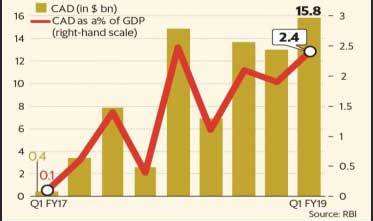
In FY 2017-18, India’s fiscal deficit was 3.5% of GDP. The government has targeted to reduce this to 3.3% in 2019. It reached 94.7% of government’s annual target during the April-August period while revenue deficit crossed the budget estimate at 113.8% in the same period. India’s CAD in FY 2017-18 grew to 1.9% of GDP. It widened to 2.9 percent of GDP in July-September 2018-19.
The Index of Industrial Production (IIP) growth in November 2018 is estimated to be 8.1% YoY. Consumer Price Index averaged to 3.6% in FY 2017-18 and eased to a low of 2.33% in November 2018 as compared to 3.31% in October.

Outlook
Economic growth will slow somewhat but remain robust, at close to 7.5 per cent in 2019 and 2020. Higher oil prices and the rupee depreciation are putting pressure on demand, inflation, the current account and public finances. However, business investment and exports will be strong, as past structural reforms – including the new Insolvency and Bankruptcy Code, smoother implementation of the Goods and Services Tax (GST), better
roads and electricity and bank recapitalization – are paying off.

III. INDUSTRY ANALYSIS
III (A) Global Steel Industry
1. Production and Consumption:
With improved steel consumption in China and investment led recovery in advanced economies, global steel consumption saw an improvement in 2017 which grew 4.7% to 1.59 billion tonnes in the year. The government’s stimulus measures and momentum in construction activities fueled steel demand in China.
Global crude steel production grew by 5.3% or 63 million tonnes in 2017 to 1691.2 million tonnes, as most economies registered good growth in steel production.

2. Capacity
The latest available data suggest that global steelmaking capacity has decreased for 2017 to 2251.2 million tonnes. However this modest adjustment (-1.3%) still isn’t enough to alleviate global excess capacity. Moreover, a number of new investment projects continue to take place around the world and global steelmaking capacity could increase by +2.3% between 2018 and 2020 in the absence of any further closures. Global excess capacity is expected to continue to be a major challenge for the global steel industry.

3. Key Challenges
Short term challenges:

• Possible escalation of trade tensions
• Rising inflationary pressure and tightening of US and EU monetary policies which may cause financial market volatilities and trouble in highly indebted emerging economies
• US imposing hefty duties on steel, aimed at dissuading China from exporting its excess metal onto US markets.
Long term challenges:
• Different economies imposing a restriction on global free trade policies

• The biggest consumer and producer, China, faces risks to its economic growth led by increasing Government restrictions and debt
• Demographic and technological changes like digitalization, de-industrialization and an ageing population

4. Outlook
World Steel Association projects global steel demand will reach 1,657.9 Mt in 2018, an increase of 3.9% over 2017. In 2019, it is forecasted that global steel demand will grow by 1.4% to reach 1,681.2 Mt. Global steel demand faces uncertainty from tensions in the global economic environment. Rising trade tensions and volatile currency movements are increasing uncertainty. Normalization of monetary policies in the US and EU could also influence the currencies of emerging economies. China steel demand growth is expected to decelerate in the absence of stimulus
measures. Both downside and upside risks exist for China. Downside risks come from the ongoing trade friction with the US and a decelerating global economy. However, if the Chinese government decides to use stimulus measures to contain the potential slowdown of the Chinese economy in the face of a deteriorating economic environment, steel demand in 2019 will be boosted.

Sanchita Bhatia

MBA-FA(2018-20)

Indian Economy- Current Status

With a 6th largest economy in the world by nominal GDP, India has faced slowdown in past 2 years because of many International and national factors.
Some of which are Trade war between USA and China, slowdown of global economy growth due to lack of demand, rising crude oil prices, falling currencies and continuous FII outflow (Net Rs – 99,496 crore in 2018) which lead the Indian Rupees to all time low and widening of India’s current account deficit to a four-year high of 2.9% of GDP. Moreover, the Indian markets are facing liquidity issues because of IL&FS defaults and the most recent growing rift between India’s central bank and the government, which result in resignation of Urjit Patel (Former RBI Governor). Apart from this, two rate hikes have been announced this year and the current monetary policy stance is one of calibrated tightening from RBI to maintain the inflation target of 4 (+/-2) percent.
However, currently the Inflation is at its lowest since June 2017 as food prices continued to decline and the current lower crude costs brought down fuel inflation.

The RBI now expects inflation to remain between 2.7 to 3.2 percent for the second half of the year which is still within the flexible range of 4 (+/-2) percent set for the Monetary Policy Committee. Also, Growth in the index of industrial production (IIP) which slowed down earlier this year have recovered in October getting a boost from demand ahead of the festival season. It rose 8.1 percent over last year in October, compared with a revised 4.5 percent growth in July, data released by the Ministry of Statistics and Programme Implementation showed. Primary goods output rose 6 percent, capital goods output increased 16.8 percent, Output of intermediate goods grew 1.8 percent, Infrastructure goods production rose 8.7 percent and Consumer durables output rose 17.6.

Indian Economy- Road Ahead

India is being viewed as a potential opportunity by investors and has emerged as one of the most attractive market for investments, with the economy having the capacity to grow tremendously. Buoyed by strong GDP growth, FII investments are also expected to improve going forward.
But on the short term the overall pace of economy is expected to be slow owing to factors such as:

  • Global growth momentum is moderating.
  • Tight financial conditions due to banking liquidity crisis are likely to have an adverse impact on consumption discretionary demand, the commercial real estate and SME segments.
  • Appointing the new RBI governor and the resigning of the former one before the term ending doesn’t show a good sign. Directly or indirectly it hampers the Central Bank credibility.
  • 2019 Election result is also going to shape the structure of India’s future economy.
  • Even though the rupee is getting stable, yet the foreign investment will take time to get back on track.
  • Government is still lacking in collecting the expected amount of GST.

Oil and Gas Sector

The oil and gas sector is one of the eight core industries in India and plays a major role in influencing decision making for all the other important sections of the economy.
India is the third largest consumer of oil and the fourth-largest Liquefied Natural Gas (LNG) importer in the world with the imports rose sharply to US$ 87.37 billion in 2017-18 from US$ 70.72 billion in 2016-17 and this demand is anticipated to grow faster than any other major economies, on the back of continuous robust economic growth. Therefore Government of India has adopted several policies to fulfil the increasing demand. The government has allowed 100% FDI in many segments of the sector, including natural gas, petroleum products, and refineries, among others. Today, it attracts both domestic and foreign investment, as attested by the presence of Reliance Industries Ltd (RIL) and Cairn India.
Crude oil consumption is expected to grow at a CAGR of 3.60 to 500 million tonnes by 2040 from 221.76 million tonnes in 2017. On the same side Natural Gas consumption is forecasted to increase at a CAGR of 4.31 per cent to 143.08 million tonnes by 2040 from 54.20 million tonnes in 2017.

Demand and Supply in Oil and Gas Sector

India imported $80.3 billion valued oil in FY17 as comparison to $70 billion in FY16. In FY18, up to November, crude oil production and imports stood at 0.48 and 2.89 mbpd respectively.
With the rapid growth of Indian economy, expansion in industries and rising urbanisation, the demand for oil and gas is going to increase rapidly. Also with rising income levels, demands for automobiles are likely to increase which will again increase the demand for oil and gas. According to OPEC, the demand for oil is going to be highest from India in coming future.


Domestic production account for more than three-quarter of the country’s total gas consumption

Industry Future Outlook

  • In August 2018, IOC announced Rs 22,000 crore capital expenditure plan for 2018-19.
  • BPCL plans to invest Rs 1.08 trillion (US$ 14.83 billion) over the coming five years for expansion of operations across business segments, of which the company plans to invest Rs 45,000 crore (US$ 6.18 billion) in the petrochemicals segment.
  • Reliance Industries Ltd (RIL), along with its partner BP plc, has decided to invest US$ 6 billion for the development of new R-series gas field.
  • Energy Infrastructure (EIL), a subsidiary of the Netherlands-based Energy Infrastructure Butano (Asia), to set up a LPG terminal in Gujrat with an investment of Rs 700 crore.
  • World’s largest oil exporter Saudi Aramco is planning to invest in refineries and petrochemicals in India as it looks to enter into a strategic partnership with the country.
  • ONGC is going to invest Rs 17,615 crore on drilling oil and gas wells in 2018-19.
  • State-run oil firms are planning investments worth Rs 723 crore in Uttar Pradesh to improve the LPG infrastructure.
  • The Oil Ministry plans to set up bio-CNG plants and allied infrastructure at a cost of Rs 7,000 crore (US$ 1.10 billion) to promote the use of clean fuel.


Shivam Daga

MBA-FA(2018-20)

Why mutual funds is a preferred investment option?

It’s time to get the right mutual funds in your investment portfolio. It is essential to find mutual funds which fulfill your interest and invest in them. You may have a bundle of ideas related to short-term and long-term investment. But the plan to invest in mutual funds would be the finest and matchless. Let’s read how it is better to invest in mutual funds.

Mutual funds are a good and positive investment

It’s essential to achieve what’s your choice of investment and consider it as your priority. Mutual funds lead to growth depending upon the mid-term and long-term investment.

Ideal for people looking for a regular cash flow

Regular cash flows come when the corpus of mutual funds is invested in multiple income instruments like bonds, preferred stocks, fixed interest debentures and so on. So, this is ideal for those who want regular cash flow. It is always rewarding if you invest systematically and expect a consistent cash flow.

Liquidity and cash-flow

Some open-ended mutual funds offer liquidity. It is smooth and simple to buy and exit the scheme as per your convenience and need. Make sure you don’t have to pay the exit fee.

Diversified investment in multiple assets

We can’t make a bridge out of the clay whose another end always falls. Similarly, if we don’t invest in multiple assets, the chances are that we may lose the opportunity to diversify our portfolio further and taking profits from them. Mutual funds offer us the opportunity to invest in multiple assets like equity, money market securities, debt instruments and so on. So, if one of the assets underperforms, we can safely get good returns from the other asset. This is like putting up an accurate and logical diversification of your investment portfolio.

Time to go for a systematic investment plan

We all have some fears and uncertainties woven into our mindset. However, making an investment in mutual funds through SIP is definitely an easier way to make a better future. Moreover, the transactional cost is also lower if the payment is done through SIP from your monthly income. All you need is to apply some attention and focus on the new schemes related to mutual funds.

What are the benefits of tax-saving mutual funds?

With the help of tax-saving mutual funds, you can avail tax benefit under section 80 of the Income tax. Equity-linked saving schemes grants you tax benefits of up to Rs 1,50,000/- which emerges like a box of chocolates that surprise people with its insights without any failure.

Mutual Fund vs. Fixed Deposit

Are you looking for some safe bets while investing money? Nobody wants to depend on a single income, but with changing lifestyles and expenses, people want to create a second source of income. The question that arises here is, “Which is a better way of saving- mutual funds or fixed deposit?”

What’s the return?

If you are looking for a positive assurance and a predetermined rate of interest, then, investing in the fixed deposit is a good idea. However, mutual funds investment depends on the market’s performance. And there is no conviction that you will get the promised amount. It all depends on how the market performs.

Is there any perfect time or should you dare to jump?

Fixed deposits are absolutely and unquestionably zero-risk investment. On the other hand, mutual funds work on the principal of change in the market’s performance. The investor can gain if the market is favourable and lose in case the market takes a downward step.

Untimely withdrawal of funds

If you are planning to make a bit previous withdrawal on your fixed deposit, you may require paying a small penalty. However, to make an unanticipated withdrawal from the mutual funds doesn’t require paying any penalty. You may need to pay 1% exit charges of the total fund invested in case the withdrawal is premature.

You gotta pay the cost

Though it may sound funny to read that it costs $0.00 to treat someone with respect. However, if you want to invest in mutual funds, you need to pay some cost to the portfolio manager. However, no such cost incurs in case of fixed deposits.

Investing in both mutual funds and fixed deposits can’t be called as a high maintenance activity. If you choose well, you can invest more. In mutual funds, your portfolio gets diversified. However, in fixed deposits, it is fixed and promises an assured rate of interest on your investment.

If you are reluctant to take any risk but still want to try your luck in mutual funds, then, try investing in a short-term period of 3 years. Once, you meet your financial goal and also gain as per the market’s performance, you will be puffed up to try more and win more from the market.