
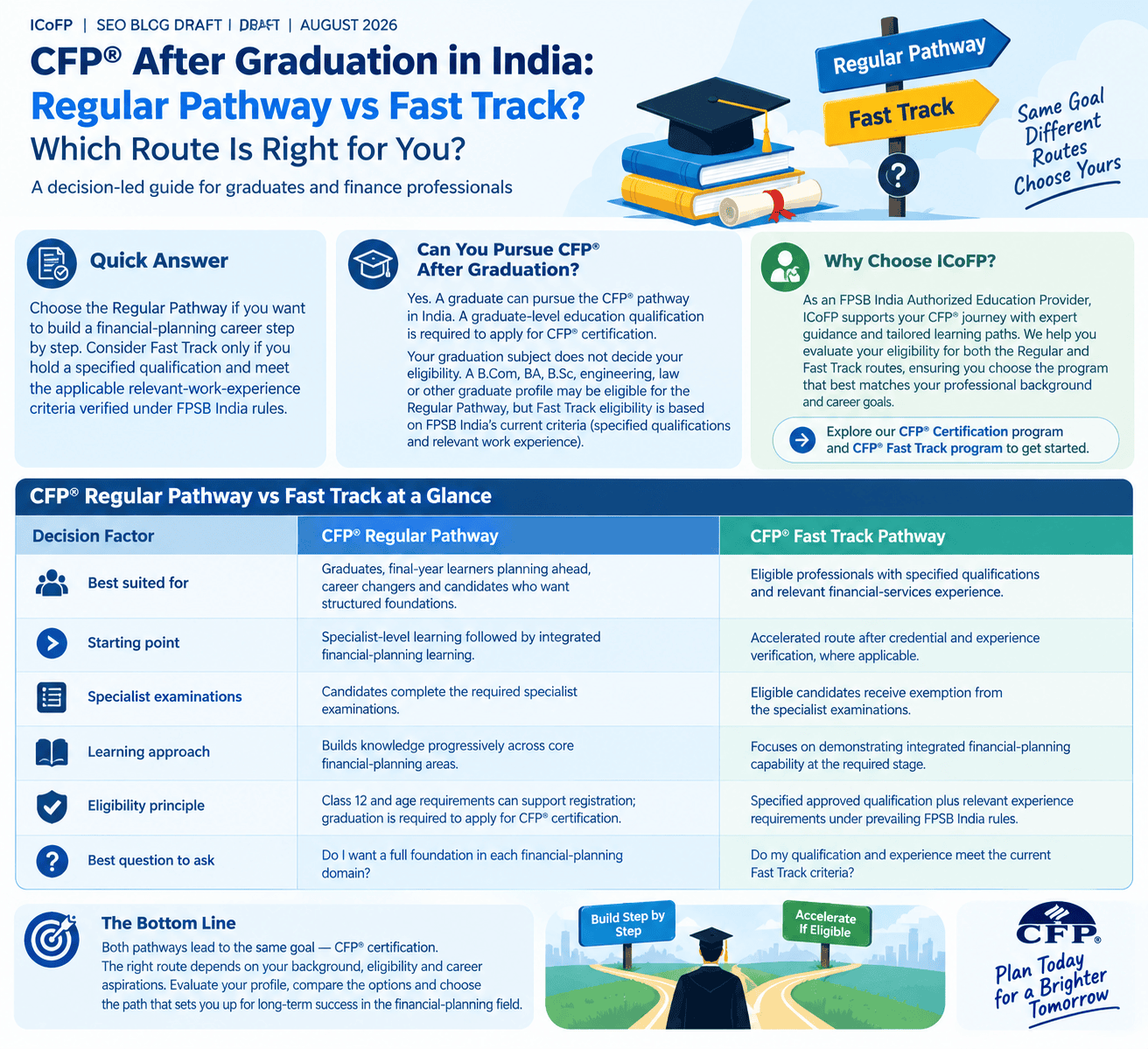
Quick answer: Choose the Regular Pathway if you want to build financial-planning career step by step. Consider Fast Track only if you hold a specified qualification and meet the applicable relevant-work-experience criteria verified under FPSB India rules.
Graduation can be an important milestone for anyone planning a career in personal finance, wealth management or financial advisory. But one question comes up repeatedly: CFP® after graduation in India through the Regular Pathway or the Fast Track Pathway, which route should you choose?
The right answer depends on your education profile, professional credentials and relevant work experience. The Regular Pathway is designed for candidates who want to build their financial-planning career step by step. The Fast Track Pathway is an accelerated option for eligible professionals with specified qualifications and relevant experience. Both pathways are part of the route to CFP® certification administered by FPSB India, and both require candidates to meet the applicable education, examination, experience and ethics requirements.
As an FPSB India Authorized Education Provider, ICoFP supports your CFP® journey with expert guidance and tailored learning paths. We help you evaluate your eligibility for both the Regular and Fast Track routes, ensuring you choose the program that best matches your professional background and career goals. Explore our CFP® Certification program and CFP® Fast Track program to get started on the right path.
CFP® Regular Pathway vs Fast Track at a Glance
Decision factor | CFP® Regular Pathway | CFP® Fast Track Pathway |
Best suited for | Graduates, final-year learners planning ahead, career changers and candidates who want structured foundations | Eligible professionals with specified qualifications and relevant financial-services experience |
Starting point | Specialist-level learning followed by integrated financial-planning learning | Accelerated route after credential and experience verification, where applicable |
Specialist examinations | Candidates complete the required specialist examinations | Eligible candidates receive exemption from the specialist examinations |
Learning approach | Builds knowledge progressively across core financial-planning areas | Focuses on demonstrating integrated financial-planning capability at the required stage |
Eligibility principle | Class 12 and age requirements can support registration; graduation is required to apply for CFP® certification | Specified approved qualification plus relevant experience requirements under prevailing FPSB India rules |
Best question to ask | Do I want a full foundation in each financial-planning domain? | Do my qualification and experience meet the current Fast Track criteria? |
The table is a planning guide, not a substitute for eligibility verification. FPSB India determines certification requirements and verifies applicable credentials and experience.
What Is the CFP® Regular Pathway?
The CFP® Regular Pathway is a structured route for candidates who want to develop knowledge across the core areas of financial planning before progressing to integrated financial planning. FPSB India describes this route as three specialist certifications followed by integrated financial-planning education, a financial plan assessment and the CFP® examination.
The specialist learning areas include:
Investment Planning
Retirement and Tax Planning
Risk and Estate Planning
Integrated Financial Planning
This route can be a strong fit if you are a recent graduate, are moving into finance from another discipline or want a deliberate, step-by-step learning journey. It helps candidates understand how individual recommendations connect to a client’s wider financial goals.
Learn how ICoFP supports aspiring planners through the CFP® Certification program.
What Is the CFP® Fast Track Pathway?
The CFP® Fast Track Pathway is an accelerated pathway recognized by FPSB India for financial-services professionals who have specified education qualifications and relevant work experience. Eligible candidates receive exemption from the three specialist examinations, but must still complete the relevant integrated requirements and meet all applicable certification conditions.
Fast Track is not simply a shorter CFP® course for every graduate. It is a pathway for profiles that satisfy the prevailing FPSB India eligibility rules. Examples of qualifications listed by FPSB India include professional credentials such as CA, CFA, CPA, CMA and ACCA, as well as certain postgraduate qualifications, MBA or PGDM credentials from approved institutions, and specified banking or insurance qualifications. Requirements can also depend on relevant work experience and credential verification.
For a profile-specific discussion, visit ICoFP’s CFP® Fast Track program page.
Which Route Is Right for You?
Choose the Regular Pathway if You Are a Recent Graduate?
The Regular Pathway may be suitable if you have recently completed graduation and want to gain a full, systematic understanding of investment planning, retirement and tax planning, risk and estate planning, and integrated financial planning.
It can also suit candidates from non-finance backgrounds who want more time to build subject confidence. A graduate degree alone does not automatically make someone eligible for Fast Track, so the Regular Pathway can be the appropriate route when you do not meet the specified Fast Track criteria.
Consider Fast Track if You Have an Eligible Credential and Relevant Experience?
Fast Track may be relevant if you have a specified professional or postgraduate qualification and the relevant experience required under current FPSB India rules. This can include certain professionals in banking, NBFCs, mutual funds, insurance, securities, broking, portfolio management, investment-advice support functions and other recognized roles, subject to FPSB India verification.
Before you plan around this route, verify both parts of the requirement:
Is your qualification included in the current Fast Track eligibility criteria?
Does your professional experience meet the relevant duration, role and documentation requirements?
Choose Based on Readiness, Not Just Speed?
A faster pathway is not automatically the better pathway. Your route should match your prior learning, work exposure and ability to apply financial-planning concepts in an integrated client context.
For example, a B.Com graduate with no relevant work experience may prefer the Regular Pathway to develop foundations. A qualified professional with the required financial-services experience may be better positioned to explore Fast Track. The final eligibility decision rests with FPSB India based on its prevailing rules and document verification.
What Does CFP® Certification Require Beyond the Pathway?
Choosing Regular or Fast Track is only one part of the journey. FPSB India’s CFP® certification framework is built around four areas: education, examination, experience and ethics.
Education
Candidates must complete a financial-planning education program that meets FPSB India’s curriculum requirements.
Examination
Candidates must pass the required certification examinations and demonstrate their ability to apply financial-planning knowledge, including through the relevant financial-plan assessment requirements.
Experience
FPSB India states that candidates need one year of supervised or three years of unsupervised relevant work experience, completed within the specified timeframe. Evidence of experience is verified by FPSB India.
Ethics
Candidates must meet the applicable ethics and fitness requirements, including agreement to the professional standards and correct use of CFP® marks once certified.
Why Can CFP® Complement Your Financial-Planning Career?
A CFP® pathway is designed around the client-focused practice of financial planning. It can be relevant for people seeking to develop capability in areas such as financial advisory, wealth management, investment planning, relationship management and personal-finance planning.
If your goal is broader wealth-management capability alongside financial-planning learning, review ICoFP’s Advanced Certification in Wealth Management. If you want to improve client conversations, needs discovery and advisory readiness, see the Being Client Ready program.
How to Choose Your CFP® Pathway After Graduation?
Review your qualifications. Identify whether you hold only a bachelor’s degree or a credential specifically recognized under the prevailing Fast Track rules.
Map your work experience. Document your role, employer, dates and responsibilities, especially if your experience is in a financial-services role.
Check the current FPSB India criteria. Eligibility rules, accepted qualifications and evidence requirements should be verified before enrolment.
Assess your knowledge base. Choose the Regular Pathway if you need a stronger foundation across the specialist subjects.
Speak with an authorized education provider. Discuss the learning format and pathway options with ICoFP, then complete the required FPSB India registration and verification process.
FAQs
Start With the Right Route
The decision between CFP® Regular Pathway vs Fast Track should be based on verified eligibility, professional readiness and your long-term learning goals. If you are a graduate building your first financial-planning foundation, the Regular Pathway can provide a structured progression. If you already have a specified credential and relevant experience, Fast Track may be worth evaluating.
Explore ICoFP’s CFP® Certification program or CFP® Fast Track program to take the next informed step. ICoFP provides 100% placement support, subject to its applicable placement-support processes and learner eligibility. Please contact ICoFP for current admissions guidance, programme details and pathway support.