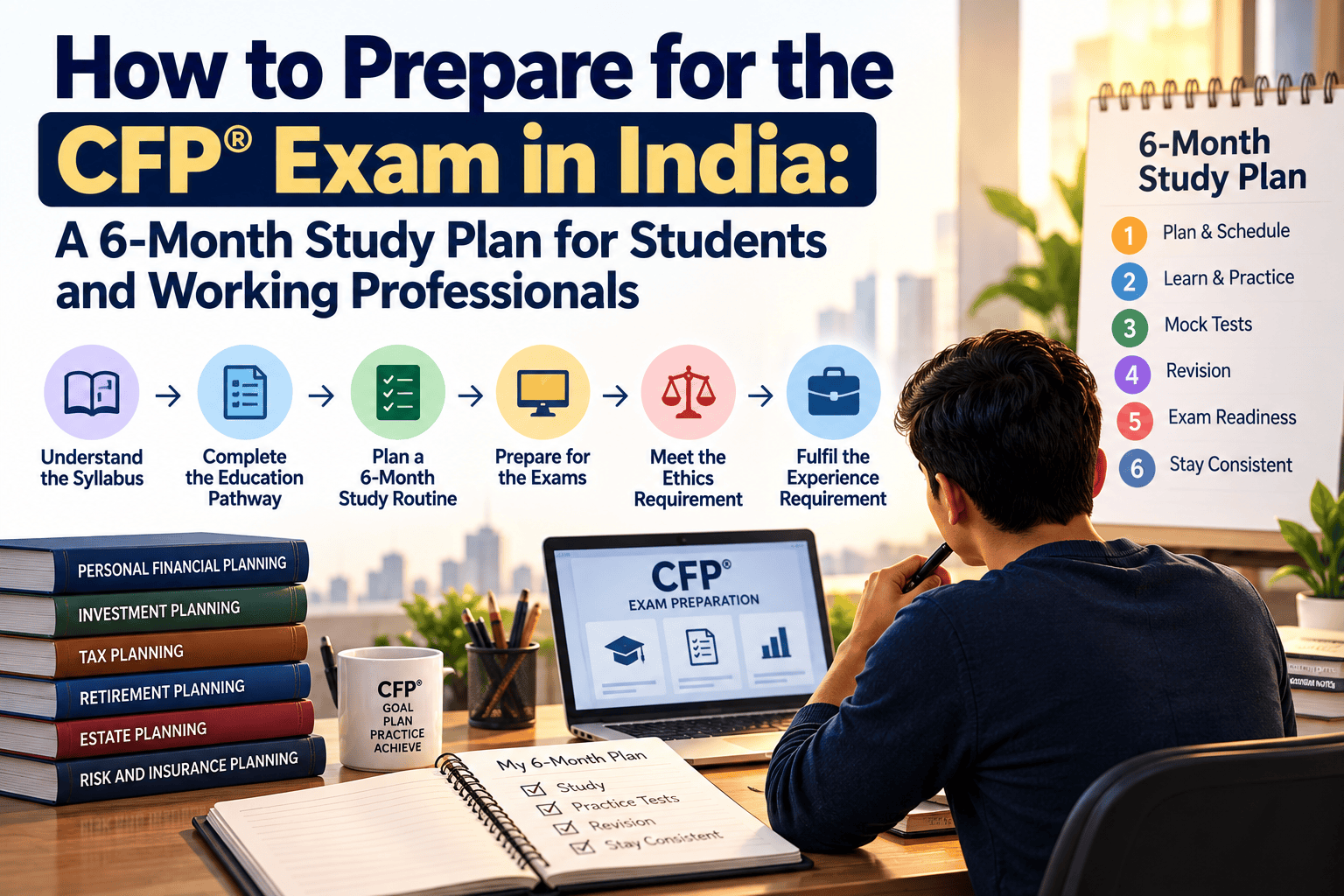
Preparing for the CFP® exam in India is easier when the syllabus, exam sequence, and weekly study routine are planned in advance. FPSB India requires candidates to complete the education pathway, pass the prescribed examinations, meet the ethics requirement, and satisfy the experience requirement before certification.
For many students and working professionals, the real challenge is not understanding the value of CFP®, but building a study plan that fits around college, work, and revision. A structured 6-month strategy helps break the journey into manageable milestones while keeping preparation aligned with the exam pattern followed by FPSB India.
What is the CFP® Exam Pathway in India?
The CFP® certification pathway in India is administered by FPSB India and consists of four specialist certification exams followed by the CFP® Final Certification Exam. Candidates must complete the required education through an FPSB India Authorized Education Provider and maintain an active registration with FPSB India to become eligible for the respective examinations.
Throughout the certification journey, candidates develop expertise in key areas of financial planning, including investment planning, retirement planning, tax planning, risk management, estate planning, and integrated financial planning. According to FPSB India, candidates are required to complete the prescribed education and successfully clear all examinations within three years from the date of enrollment.
Where Can Candidates Take the Exam?
FPSB India offers candidates the flexibility to take the CFP® certification exams either through an online proctored format from home or at authorized DEXIT test centres. This allows candidates to choose the mode that best suits their preferences and schedule, making it easier to plan and complete their certification journey with confidence.
How should you study for the CFP® exam in 6 months?
A 6-month plan works well for learners who want enough time for concept-building, practice, and revision without stretching preparation too long. It is especially effective for working professionals who need a repeatable weekly timetable.
Months 1 and 2: Build concept clarity
Focus first on the core planning domains and understand how each topic connects to real financial planning decisions. During this phase, study the basics of investment planning, retirement planning, tax planning, insurance, and estate concepts with short daily revision notes.
Suggested weekly routine:
● 5 study days per week.
● 90 to 120 minutes on weekdays.
● 3 to 4 hours on weekends.
● 1 revision block at the end of every week.
Months 3 and 4: Shift to application and problem solving
Once the concepts are familiar, move to case-based preparation and question practice. This is the stage to improve recall, identify weak areas, and get used to applying planning concepts across modules.
Suggested Weekly Study Routine:
To maintain consistent progress, consider following this study schedule each week during your preparation:
● 3 days: Focus on learning new concepts and revising theory.
● 2 days: Solve MCQs and topic-wise practice questions to reinforce your understanding.
● 1 day (Weekend): Attempt a sectional mock test under timed conditions.
● 1 day: Review your mock test and practice sessions, analyse mistakes, and revise weak areas before starting the next week's topics.
Months 5 and 6: Full mock tests and exam readiness
The final two months should focus on timed practice, integrated case handling, and last-mile revision. The goal is to improve accuracy, speed, and confidence before the actual exam.
Suggested weekly routine:
● 2 full mock or half-length timed tests each week.
● 1 error-log review session.
● 2 short revision sessions for formulas, tax rules, and planning frameworks.
● 1 final weekly recap of weak topics.
What if you need a 3-month or 12-month plan?
A 3-month plan suits candidates who already have a strong finance background or are using a guided pathway such as the CFP® Fast Track program at ICoFP. This approach demands a heavier weekly load, frequent mocks, and strict discipline.
A 12-month plan is better for students, career switchers, and professionals with unpredictable work schedules. It gives more room for repetition, slower concept-building, and better retention across the full CFP® syllabus.
How do guided programs improve preparation?
Guided programs help reduce time wasted on planning, sequencing, and doubt resolution. ICoFP’s CFP® Fast Track pathway highlights weekend virtual classes, while its broader PGDFP™ program supports learners who want deeper financial planning and wealth management preparation alongside career development.
This matters because many candidates struggle not with motivation, but with consistency. A guided format can improve preparation by giving learners fixed sessions, faculty support, and a defined revision rhythm.
What is a smart mock test strategy?
Mock tests should not begin only at the end of preparation. The better approach is to start sectional practice after the concept phase, then move gradually into full timed tests.
Use this sequence:
● Start sectional quizzes after the first 6 to 8 weeks.
● Move to mixed-topic tests in the middle phase.
● Attempt timed mocks in the last 8 weeks.
● Keep an error log for repeated mistakes.
● Revise weak topics within 24 to 48 hours after every mock.