
What Is the Right Financial Advisory Certification in India?
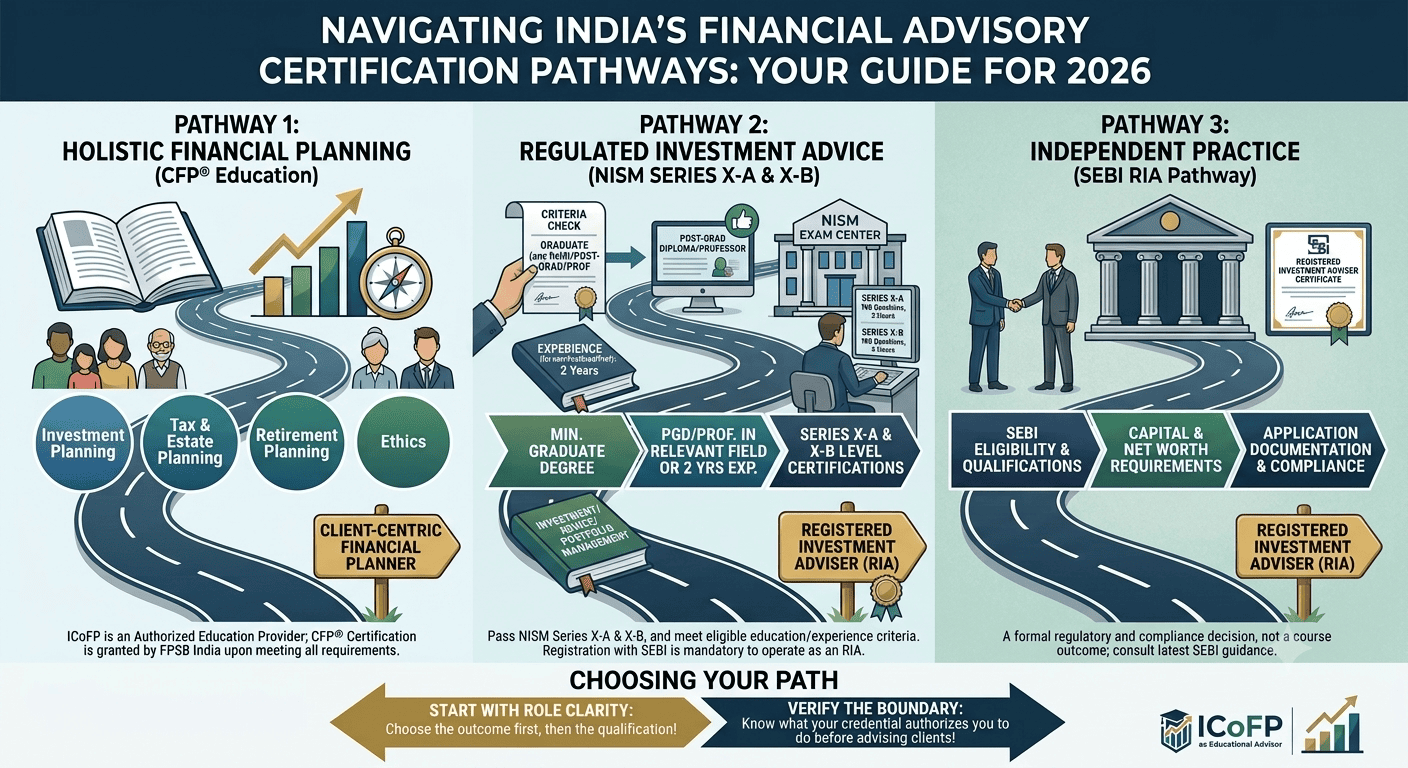
The right financial advisory certification India pathway depends on the career you want to build. If your goal is holistic personal financial planning, including goals, cash flow, risk, tax, retirement and estate considerations, the CFP® pathway is relevant. If your role involves regulated investment advice in securities markets, the NISM Investment Adviser examinations and SEBI registration requirements are central. A qualification alone does not automatically make a person a SEBI Registered Investment Adviser, or RIA.
For many learners, the practical decision is not CFP® or NISM. It is understanding what each pathway prepares you to do, what it does not authorise you to do, and which sequence fits your current education, experience and intended role.
Why Does This Distinction Matter in 2026?
Indian financial-services careers increasingly overlap across financial planning, wealth management, distribution, private banking, research and advisory. Yet the professional expectations, client responsibilities and regulatory boundaries are different.
NISM states that an individual investment adviser, the principal officer of a non-individual investment adviser, and persons associated with investment advice must pass both NISM Series X-A, Investment Adviser Level 1, and NISM Series X-B, Investment Adviser Level 2, to fulfil the applicable certification requirements under the SEBI Investment Advisers Regulations, 2013 (Source: NISM, accessed August 2026).
That makes clarity essential for students and working professionals searching for a financial advisor certification India option. A strong course decision should consider:
The work you want to perform
The client segment you want to serve
Whether your future role involves regulated securities advice
Your academic background and professional experience
The education, examination, ethics and experience standards associated with the pathway
What Does Financial Advisory Mean in India?
Financial advisory is a broad term. In a career context, it may describe client-facing work across personal finance, investments, insurance, wealth management, retirement planning, estate planning, mutual funds, portfolio services or broader financial-services relationships.
However, terms such as “investment advice” can have specific regulatory implications. Do not assume that completing a course or holding a credential, by itself, permits you to provide fee-based or regulated investment advice. Always verify the current legal and registration requirements before offering services to clients.
How should you study for the CFP® exam in 6 months?
| Pathway | Core Purpose | Best Suited To | Important Clarification |
|---|---|---|---|
| CFP® certification India pathway | Builds structured knowledge in personal financial planning | Aspirants seeking careers in financial planning, wealth management and client-centric advisory roles | CFP® certification is granted by FPSB India when its requirements are met. ICoFP provides CFP® education as an Authorized Education Provider and does not award the CFP® certification |
| NISM Investment Adviser certification | Tests knowledge relevant to investment-adviser roles and regulatory requirements | Professionals whose role requires the NISM Investment Adviser examination route | NISM identifies Series X-A as Level 1 and Series X-B as Level 2. Both levels are required for the relevant Investment Adviser certification requirement |
| SEBI RIA certification pathway | Regulatory registration pathway for eligible investment advisers | Individuals or entities intending to operate as registered investment advisers | Passing examinations is only one element. Applicants must meet the applicable SEBI eligibility, qualification, certification and other registration conditions |
What Is the CFP® Pathway in India?
The CFP® certification pathway is designed for individuals who want structured expertise in personal financial planning. It covers the connected decisions people make around their money rather than only one product category.
A learner pursuing CFP® certification India typically develops knowledge across areas such as:
Investment planning
Retirement and tax planning
Risk and estate planning
Integrated financial planning
Client communication, ethics and financial-plan development
At ICoFP, the CFP® certification program is positioned for learners who want an instructor-led education route aligned to the CFP® curriculum. Candidates must complete the applicable FPSB India requirements, including education, examinations, experience and ethics, to become CFP® professionals.
Who Should Consider CFP® Education?
CFP® education can be relevant if you are:
A graduate exploring a long-term financial-planning career
A BFSI professional who wants deeper client-planning capability
A wealth-management aspirant seeking a broader personal-finance framework
A client-facing professional who wants to connect investments with real-life financial goals
Can CFP® Alone Make You a SEBI RIA?
No. CFP® education or certification should not be presented as an automatic SEBI RIA licence or registration. The applicable registration process and current regulatory conditions must be reviewed separately. This distinction protects both professionals and clients.
What Is NISM Series X-A and X-B?
NISM Series X-A is the Investment Adviser Level 1 Certification Examination, while NISM Series X-B is the Investment Adviser Level 2 Certification Examination. According to NISM, both levels are required for an individual investment adviser, the principal officer of a non-individual investment adviser, and persons associated with investment advice to fulfil the certification requirement under the SEBI Investment Advisers Regulations, 2013.
NISM's Level 1 curriculum includes personal financial-planning fundamentals, evaluating a client's financial position, debt management, Indian financial markets, investment products, portfolio construction, regulations, ethics and grievance redressal. This explains why NISM is often part of searches for a SEBI RIA certification pathway.
Who Should Consider NISM Investment Adviser Examinations?
Consider this route if you are:
Working toward an eligible registered investment-adviser role
Planning a career that involves regulated investment advice
A professional whose employer requires Investment Adviser examination credentials
Seeking formal knowledge of Indian securities-market regulations and investment-advisory practices
What Is the SEBI RIA Pathway?
A SEBI Registered Investment Adviser, or RIA, is an adviser registered under the applicable SEBI framework. The pathway involves more than clearing an examination. Depending on the applicant and current rules, it may involve qualification criteria, certification, experience, net-worth or capital requirements, application documentation, compliance processes and ongoing obligations.
Because regulations can change, a prospective applicant should consult the latest SEBI Investment Advisers Regulations and official guidance. Do not rely on course marketing pages, social posts or outdated blogs for a final compliance decision.
How Should You Choose Between CFP®, NISM and the RIA Pathway?
Choose CFP® Education If You Want to Become a Financial-Planning Professional
Choose NISM Investment Adviser Examinaations If Your Role Requires Them
Consider the SEBI RIA Pathway If You Plan to Practise as a Registered Adviser
Consider a Broader Financial-Planning Diploma If You Are a Graduate Seeking BFSI Readiness
How Can a Graduate Build a Financial Advisory Career?
A graduate can build a relevant foundation through a deliberate sequence.
Choose the career outcome. Decide whether you want a role in financial planning, wealth management, investment advisory, relationship management, research, distribution or another BFSI specialisation.
Build technical knowledge. Study products, financial markets, client suitability, risk, taxation and financial-planning principles appropriate to your target role.
Choose the right credential. CFP® education is relevant to holistic financial planning. NISM Investment Adviser examinations are relevant to the regulated investment-adviser route. They serve different, though sometimes complementary, purposes.
Develop client readiness. Advisory work requires discovery conversations, financial-plan communication, documentation, ethics and relationship skills.
Verify the regulatory boundary. Before advising clients or presenting yourself as an investment adviser, verify applicable SEBI and NISM requirements.
ICoFP's Being Client Ready program is designed to strengthen practical client-facing capability for BFSI learners as part of step 4 above.
Which ICoFP Program Fits Your Career Goal?
| Your Objective | Relevant ICoFP Pathway | Why It May Fit |
|---|---|---|
| Build structured financial-planning knowledge | CFP® Certification | For learners pursuing the CFP® education route through an Authorized Education Provider |
| Build broader post-graduate financial-planning and BFSI skills | PGDFP™ | For graduates seeking a financial-planning and wealth-management-oriented diploma pathway |
| Develop wealth-management knowledge | Advanced Certification in Wealth Management | For learners exploring wealth-management roles and capabilities |
| Improve client-facing advisory readiness | Being Client Ready | For communication, relationship and client-readiness skills in BFSI roles |
| Experienced BFSI professional seeking an expedited CFP® education option | CFP® Fast Track | For eligible professionals; final eligibility and document approval remain subject to the applicable FPSB process |
What Should You Check Before Enrolling in a Financial Advisory Course?
Before choosing a financial planning course India option, ask these questions.
Does the course match my intended role?
Is the course education, an examination-preparation program, a credential, or a regulatory-registration route?
Who issues the credential or examination certificate?
What are the current eligibility, examination, ethics and experience requirements?
Does the course help with technical knowledge, client skills, or both?
Will I need additional certifications for my intended role?
What current rules apply before I provide regulated investment advice?
Is the provider clear about what the course does and does not authorise me to do?
FAQs
Final Takeaway
The best financial advisory certification India decision starts with role clarity. Choose CFP® education when you want to develop a holistic financial-planning career. Choose the NISM Investment Adviser examination route when your role requires it. Treat the SEBI RIA pathway as a formal regulatory and compliance decision, not merely as a course completion outcome.
If you want help choosing a learning route based on your background and career objective, explore ICoFP's CFP® certification program, PGDFP™ and Advanced Certification in Wealth Management.