
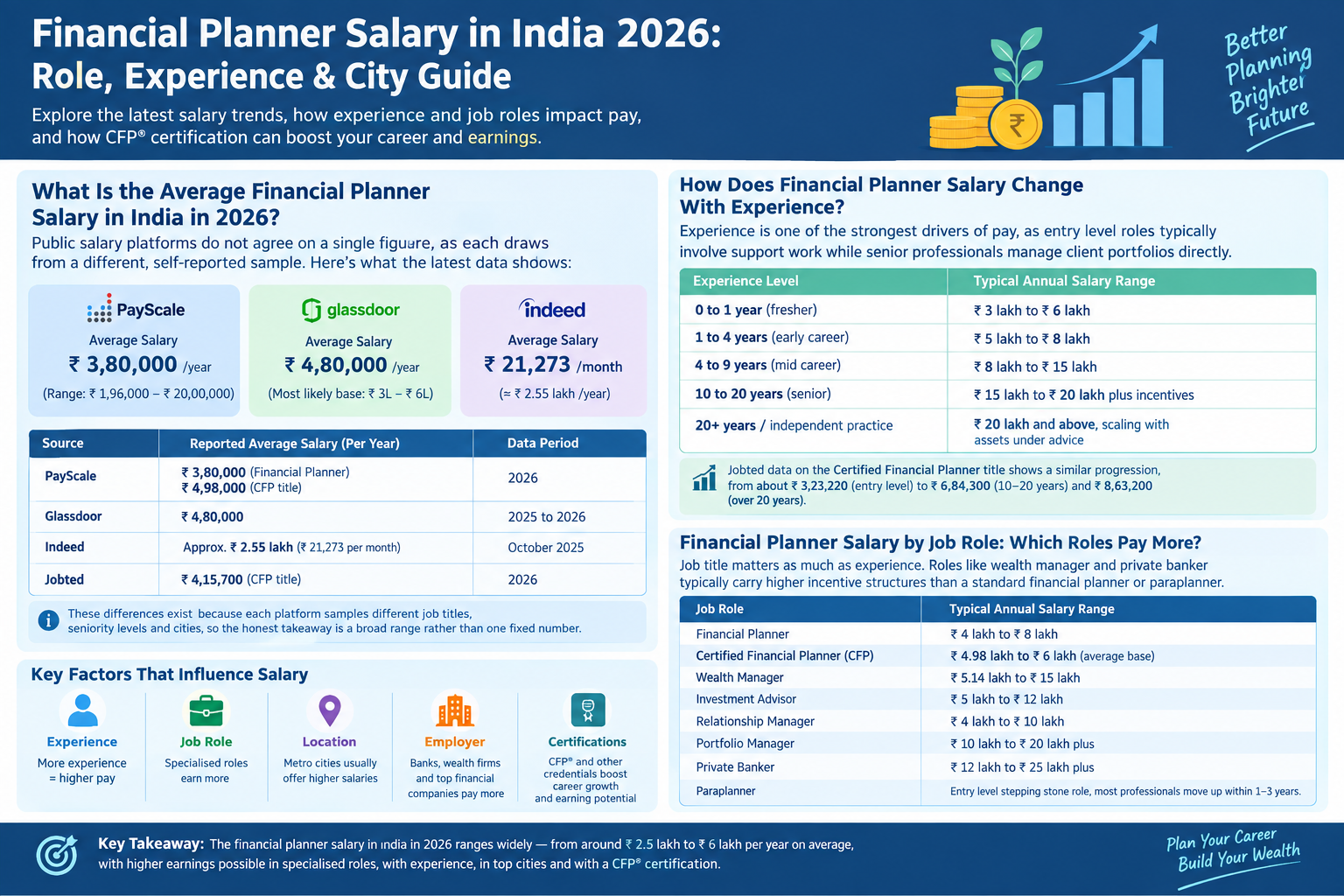
The financial planner salary in India in 2026 varies widely by job title, experience, city, employer and client responsibility, with public salary databases reporting national averages anywhere between roughly ₹ 3.8 lakh and ₹ 6 lakh per year, and role specific pay climbing far higher for wealth management and private banking positions. This guide compares the latest publicly available salary data, explains what actually drives pay in this profession, and shows how professional credentials such as CFP® certification connect to real career outcomes.
Because salary estimates come from different platforms with different sample sizes, this article treats every figure as a reported range rather than a guaranteed outcome, and each data point is dated so reade₹ can judge how current it is.
What Is the Average Financial Planner Salary in India in 2026?
Public salary platforms do not agree on a single financial planner salary in India figure because each draws from a different, self reported sample of respondents.
PayScale reports an average base salary of about ₹ 3,80,000 per year for the job title Financial Planner in 2026, with a range of roughly ₹ 1,96,000 to ₹ 20,00,000 depending on experience and employer.
Glassdoor places the average Financial Planner salary closer to ₹ 4,80,000 per year, with a most likely base pay range of ₹ 3 lakh to ₹ 6 lakh.
Indeed reports a lower average of about ₹ 21,273 per month, which works out to roughly ₹ 2.55 lakh per year, reflecting a broader and more entry heavy sample of listings.
Source | Reported Average Salary (Per Year) | Data Period |
PayScale | ₹ 3,80,000 (Financial Planner); ₹ 4,98,000 (CFP title) | 2026 |
Glassdoor | ₹ 4,80,000 | 2025 to 2026 |
Indeed | Approx. ₹ 2.55 lakh (₹ 21,273 per month) | October 2025 |
Jobted | ₹ 4,15,700 (CFP title) | 2026 |
These differences exist because each platform samples different job titles, seniority levels and cities, so the honest takeaway is a broad range rather than one fixed number.
How Does Financial Planner Salary Change With Experience?
Experience is one of the strongest drive₹ of pay in this profession, since entry level roles typically involve support work while senior professionals manage client portfolios directly.
Experience Level | Typical Annual Salary Range |
0 to 1 year (fresher) | ₹ 3 lakh to ₹ 6 lakh |
1 to 4 yea₹ (early career) | ₹ 5 lakh to ₹ 8 lakh |
4 to 9 yea₹ (mid career) | ₹ 8 lakh to ₹ 15 lakh |
10 to 20 yea₹ (senior) | ₹ 15 lakh to ₹ 20 lakh plus incentives |
20 plus yea₹ / independent practice | ₹ 20 lakh and above, scaling with assets under advice |
Jobted data on the Certified Financial Planner title shows a similar progression, moving from about ₹ 3,23,220 for entry level professionals to ₹ 6,84,300 for those with 10 to 20 yea₹ of experience, and ₹ 8,63,200 for those with over 20 yea₹ in the field.
Financial Planner Salary by Job Role: Which Roles Pay More?
Job title matte₹ as much as experience, since roles like wealth manager and private banker typically carry higher incentive structures than a standard financial planner or paraplanner position.
Job Role | Typical Annual Salary Range |
Financial Planner | ₹ 4 lakh to ₹ 8 lakh |
Certified Financial Planner (CFP) | ₹ 4.98 lakh to ₹ 6 lakh average base |
Wealth Manager | ₹ 5.14 lakh to ₹ 15 lakh |
Investment Advisor | ₹ 5 lakh to ₹ 12 lakh |
Relationship Manager | ₹ 4 lakh to ₹ 10 lakh |
Portfolio Manager | ₹ 10 lakh to ₹ 20 lakh plus |
Private Banker | ₹ 12 lakh to ₹ 25 lakh plus |
Paraplanner | Entry level stepping stone role, most professionals move up within 12 to 18 months |
Indeed's employer level data shows Wealth Manager postings ranging from about ₹ 5,14,802 on average up to ₹ 20,00,000 at firms such as India Infoline Finance, reflecting how much employer brand and incentive structure affect real world pay.
Financial Planner Salary by City: Which Cities Pay the Most?
City of employment strongly affects the financial planner salary in India, since metros host more wealth management, private banking and HNI advisory roles than smaller markets.
City | Reported Salary Range or Average |
Mumbai | ₹ 60,000 to ₹ 2,00,000 per month (CFP roles) |
Bengaluru | ₹ 55,000 to ₹ 1,80,000 per month; ₹ 34,093 per month average for Financial Planner (Indeed) |
Delhi NCR | ₹ 50,000 to ₹ 1,50,000 per month; Wealth Manager average ₹ 8,09,499 per year (Delhi, Indeed) |
Hyderabad | ₹ 45,000 to ₹ 1,20,000 per month; Wealth Manager average ₹ 9,42,893 per year (Indeed) |
Pune | ₹ 45,000 to ₹ 1,20,000 per month; Wealth Manager average ₹ 6,82,707 per year |
Kolkata | Wealth Manager average ₹ 6,06,353 per year (Indeed) |
Tier 2 cities | ₹ 35,000 to ₹ 90,000 per month |
Hyderabad and Delhi currently report the highest average Wealth Manager pay among metros tracked by Indeed as of July 2026, ahead of Mumbai, Pune and Kolkata, largely due to concentrated private banking and BFSI hiring in these markets.
Does CFP Certification Increase Financial Planner Salary?
CFP® is a professional certification awarded by FPSB India, not a job title by itself, so it does not guarantee a fixed salary outcome, but it is associated with stronger pay bands across public datasets.
PayScale places the average base salary for professionals carrying the Certified Financial Planner (CFP) job title at about ₹ 4,98,000 per year in 2026, while professionals simply tagged with CFP certification (in other job titles) average ₹ 5,82,000 per year, suggesting the credential adds value even outside a dedicated CFP job title.
FPSB India's own reporting also points to a 24 percent rise in net salary for CFP professionals nationally, based on a Salary Experts report, though this figure should be read as a directional signal rather than a fixed pe₹onal outcome.
India closed 2025 with 3,534 CFP® professionals nationally, a 9.9 percent year on year increase, against an estimated requirement of around 2.5 lakh CFP® professionals by 2040, which points to a pe₹istent demand supply gap that can support long term earning potential for certified professionals.
How Can You Increase Your Financial Planner Salary in India?
Career growth in financial planning tends to follow a predictable pattern: professionals who build client facing skills, add credentials and move into wealth focused roles report the strongest long term pay growth.
Practical, evidence based ways professionals typically use to grow their earning potential include:
Earning the CFP® certification through an FPSB India Authorized Education Provider, which is associated with stronger average pay across PayScale and industry data.
Moving from paraplanning or support roles into direct client advisory, wealth management or private banking positions, where incentive structures are meaningfully higher.
Building expertise in retirement planning, taxation, estate planning and investment products, since these are core competencies employe₹ reward with client owne₹hip.
Gaining experience in metro markets such as Mumbai, Delhi NCR and Hyderabad, where wealth management hiring and incentive-heavy roles are more concentrated.
Developing digital advisory and client communication skills, which are increasingly valued as financial planning shifts toward hybrid, tech-enabled client servicing models.
Professionals exploring this pathway can review the CFP® Certification cou₹e or the accelerated CFP® Fast Track program to unde₹tand the eligibility and certification route in more detail.
For graduates who want an industry ready foundation before specializing, the Post Graduate Diploma in Financial Planning (PGDFP) is designed as a structured entry point into wealth management and advisory caree₹.
Those targeting high net worth client servicing and portfolio management roles can also explore the Advanced Certification in Wealth Management (ACWM), which builds on core financial planning skills for more senior client mandates.
Candidates preparing to enter the workforce can review interview and onboarding readiness through the Being Client Ready program, which focuses on the practical, client facing skills that employe₹ evaluate during placement.
What Do Real Placement Outcomes Look Like?
Beyond public salary averages, actual placement outcomes at financial planning institutes offer a grounded view of entry level pay in this field.
For context on institute-linked outcomes, prospective students can review the ICoFP Placement Advantage and detailed Placements at a Glance pages, which outline recruiter participation and placement support processes; ICoFP provides 100% placement support rather than a placement guarantee.
Details of recruiting partne₹ and past placement highlights are available on the Placement Highlights and Recruite₹ pages.