What Is CFP® Certification in India?
CFP® certification is a professional credential associated with financial planning competence and professional standards. In India, the certification process is administered by FPSB India. The current pathway information describes three specialist certifications followed by the FPSB® Integrated Financial Planning course and a two-stage evaluation comprising the Financial Plan Assessment and CFP® Exam. Candidates must also satisfy applicable experience and ethics requirements.
A CFP® professional may work with individuals and families on connected financial decisions such as investment planning, risk management, retirement planning, tax planning and estate planning. The role requires more than product knowledge: it requires structured fact-finding, analysis, communication, ethical conduct and the ability to develop practical financial recommendations.
How to Become a CFP® in India: Step-by-Step Guide?
Step 1: Understand the CFP® Career Path
Before enrolling, understand what financial planning work involves. A financial planner may help clients define goals, assess their existing financial position, identify risks, create an investment strategy, plan for retirement and review progress over time. If you enjoy analytical work, client communication and long-term problem solving, CFP® education may align with your career goals.
Step 2: Check Your Eligibility
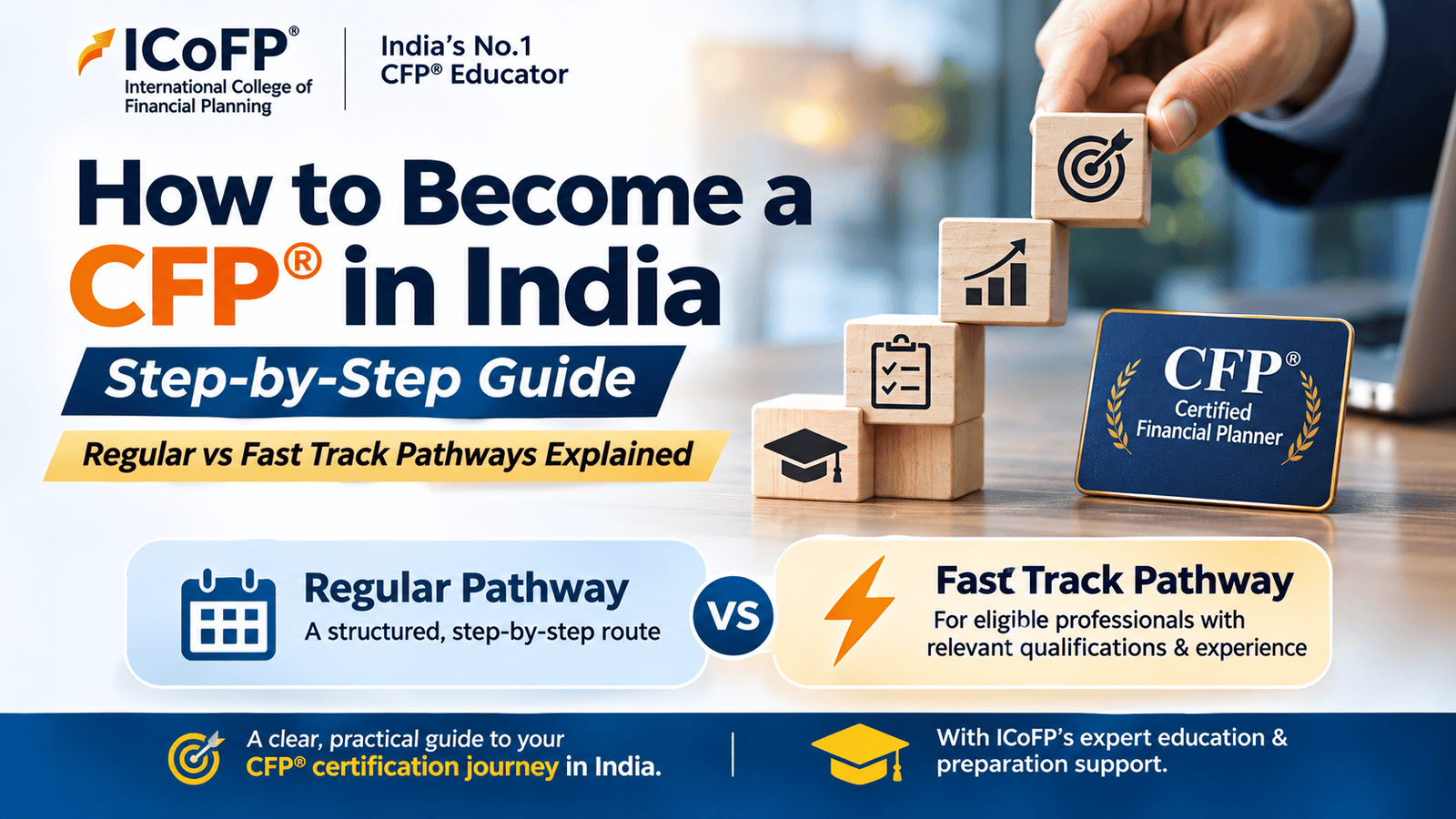
Step 3: Choose the Regular or Fast Track Pathway
Step 4: Complete the Required Education
Step 5: Prepare for the Assessments and Examinations
Step 6: Complete the Financial Plan Assessment and CFP® Exam
Step 7: Meet Experience and Ethics Requirements
Step 8: Apply for CFP® Certification Through FPSB India
Regular vs Fast Track CFP® Pathways: Which One Should You Choose?
The most important difference is the candidate profile each pathway is designed to serve. Regular candidates typically need a structured route through the prescribed learning and evaluation process. Fast Track candidates must demonstrate that their existing qualifications and professional experience meet FPSB India’s specified criteria. Fast Track is not automatically available merely because a candidate has worked in finance.
Comparison factor | Regular Pathway | Fast Track Pathway |
Typical candidate | Student, graduate or career changer seeking structured learning | Eligible financial-services professional with specified qualifications and experience |
Education route | Complete the applicable specialist education and integrated course | Existing credentials may receive recognition after verification |
Main decision | Select an education schedule and preparation format | Confirm eligibility before choosing the accelerated route |
Final evaluation | Financial Plan Assessment and CFP® Exam, as applicable | Financial Plan Assessment and CFP® Exam, as applicable |
Certification authority | FPSB India | FPSB India |
Who Should Consider the Regular Pathway?
The Regular Pathway may suit graduates, students and professionals transitioning into financial planning. It gives candidates an opportunity to build foundational knowledge systematically and connect concepts across investments, risk, retirement, tax and estate planning. It may also suit learners who prefer a fixed study structure, instructor support and progressive examination preparation.
Who Should Consider the Fast Track Pathway?
The Fast Track Pathway may suit professionals whose qualifications and experience already demonstrate relevant financial-planning competence. FPSB India’s current guidance says that eligible applicants may bypass education and examination for specified specialist areas after credential verification and proceed to the Integrated Financial Planning course. Because the criteria are profile-specific, candidates should obtain confirmation before assuming they qualify.
How Should You Choose a CFP® Education Provider?
Choosing the right provider can influence your learning experience, preparation quality and confidence. When comparing the Best CFP® Coaching Institutes in India, examine evidence rather than relying only on promotional rankings.
Whether the provider is an FPSB India Authorized Education Provider.
Whether the faculty can explain technical concepts through practical cases.
Whether the programme supports your chosen Regular or Fast Track route.
Whether the delivery format suits your schedule, location and learning style.
Whether the provider offers mock practice, doubt resolution and assessment guidance.
Whether career guidance and placement support are clearly described without employment guarantees.
Whether programme information, admissions guidance and support policies are current.
How Does ICoFP Support CFP® Aspirants?
ICoFP offers education and preparation support for candidates pursuing CFP® certification. You can review the CFP® Certification programme and the CFP® Fast Track programme to understand the available programme routes.
Candidates who want broader financial-planning and wealth-management learning can also explore the PGDFP™ programme and Advanced Certification in Wealth Management. Those seeking practical client-facing skills can review the Being Client Ready programme. These programmes serve different learning objectives, so compare the curriculum and entry requirements before making a decision.
What Skills Should You Build Alongside CFP® Education?
Client discovery and active listening.
Goal-based financial planning.
Investment and risk analysis.
Retirement and tax planning fundamentals.
Financial modelling and spreadsheet confidence.
Clear written and verbal communication.
Ethical decision-making and professional discipline.
Ability to explain complex financial ideas in simple language.
A qualification is more valuable when paired with practical capability. Use case studies, supervised projects, internships, role-play conversations and financial-plan analysis to develop confidence. Candidates should also stay aware of applicable regulatory and professional requirements and avoid presenting themselves as authorised to provide services they are not legally permitted to provide.
What Career Opportunities Can CFP® Education Support?
CFP® education may support career exploration in personal financial planning, wealth management, investment advisory support, relationship management, insurance planning, retirement planning and client servicing. The exact role depends on the employer, the candidate’s experience, location, applicable regulations and any additional qualifications or registrations required for the work.
Do not view certification as an automatic employment guarantee. Career outcomes depend on skills, interview performance, location, market demand, experience and employer requirements. A provider’s placement support can help with preparation and opportunities, but employment decisions remain with employers.
Frequently asked questions
Final Checklist Before You Enrol
Read the latest FPSB India pathway requirements.
Confirm whether Regular or Fast Track is appropriate for your profile.
Prepare academic and experience documents for verification.
Compare curriculum, faculty and preparation support.
Understand the assessment and examination stages.
Ask how career support is delivered and avoid guarantee-based claims.
Choose a study format you can follow consistently.