Introduction
If you want to build a career in wealth advisory, private banking, financial planning, or investment distribution, choosing the right wealth management certification in India is one of the first big decisions. In 2026, the market offers multiple options, but the best fit depends on your education level, target job role, and how quickly you want to become employable.
Some learners need a fast, job-oriented starting point. Others want a broader financial planning pathway that supports long-term growth into advisory, relationship management, portfolio support, or client-facing finance roles. That is why comparing certifications only by name is not enough. You need to understand what each option is designed to do.
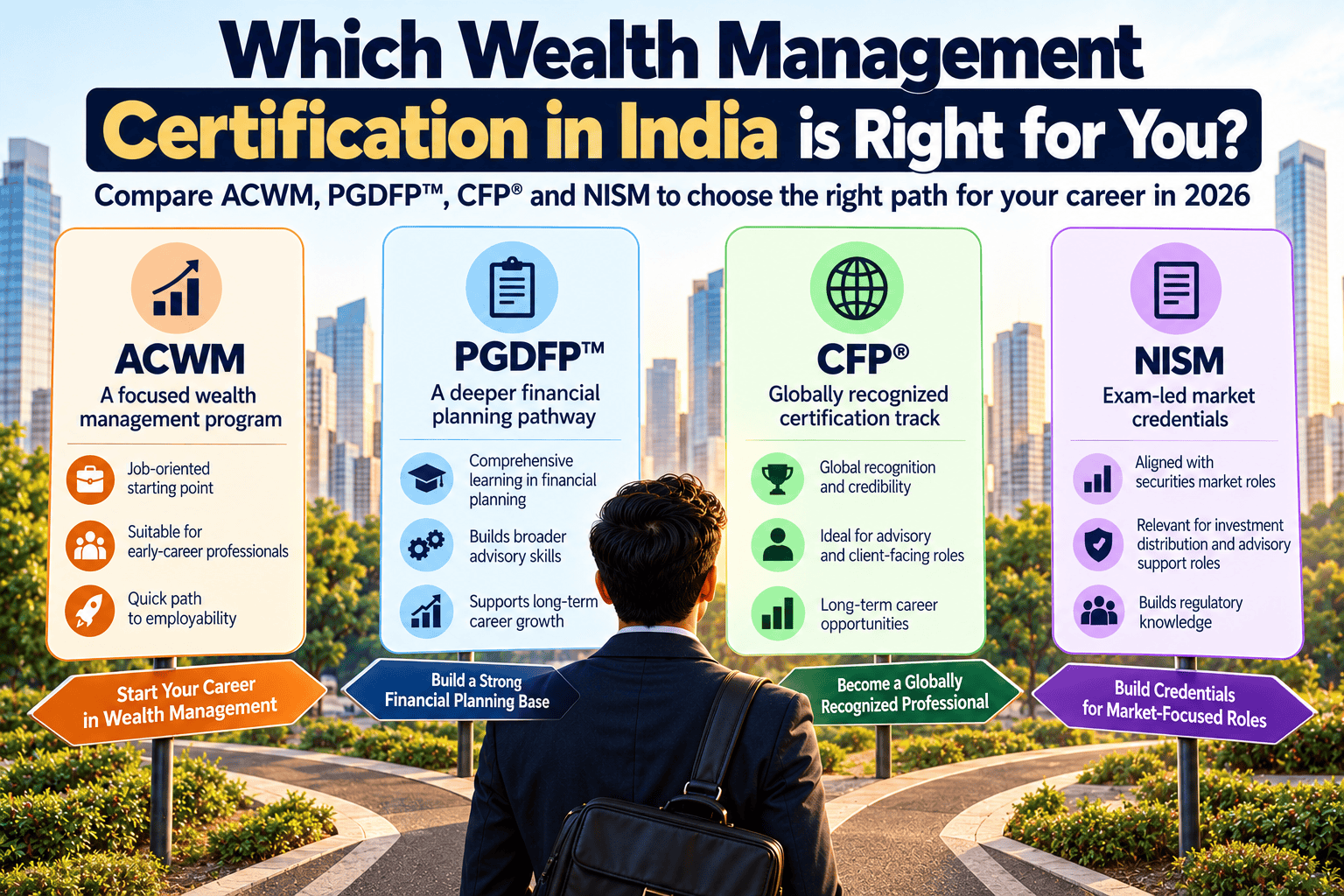
At ICoFP, this discussion usually comes down to four common pathways: a focused wealth management program such as ACWM, a deeper financial planning route such as PGDFP™, the globally recognized CFP® certification track through an authorized education provider, and exam-led market credentials such as NISM-linked learning. Each serves a different career stage and purpose.
What does wealth management certification mean in India?
In India, wealth management certification is a broad term. It may refer to a short career-oriented program, a professional education track linked to financial planning, or an exam-based credential that helps candidates build knowledge in investments, taxation, regulation, retirement planning, or advisory practice. This is why students often confuse certifications, diplomas, and professional pathways.
For example, some programs are built to help freshers enter BFSI roles faster, while others are better for professionals who want deeper client advisory expertise. A smart decision starts with role clarity: do you want an entry-level wealth management job, a broader financial planning career, or a long-term path toward advisory specialization?
Top options to consider in 2026
The most practical choices for Indian learners usually fall into four buckets:
● ACWM for learners who want a focused wealth management foundation and faster role readiness.
● PGDFP™ for learners who want wider exposure across financial planning, markets, tax, and wealth management.
● CFP® education pathway for candidates aiming at a recognized long-term financial planning credential through an authorized education provider.
● NISM-linked learning for exam-oriented knowledge in specific market and investment domains.
1. ACWM for focused wealth management skills
ICoFP’s Advanced Certification in Wealth Management (ACWM) is designed for students and graduates who want to build practical knowledge in areas such as portfolio construction, financial planning, and risk analysis. It is a strong option when your goal is to enter wealth management or relationship-driven finance roles without waiting for a long academic cycle.
This route is especially useful if you want role-focused preparation, industry-relevant concepts, and a clearer bridge to early BFSI opportunities. It is not trying to be everything at once. Its strength is focus.
2. PGDFP™ for broader career depth
If you want stronger breadth, PGDFP™ at ICoFP is a deeper pathway that combines financial markets, wealth management, tax planning, and financial planning concepts into one structured learning track. This is a better fit for candidates who want to keep more career doors open across advisory, planning, banking, and investment-related roles.
A broader program often helps when you are still exploring whether your long-term fit is wealth management, financial planning, investment advisory support, or a client-facing finance profile. It builds transferable understanding rather than only role-specific familiarity.
You can also review the PGDFP™ curriculum overview to understand how the diploma connects financial planning topics with wealth management applications.
3. CFP® pathway for long-term planning careers
For candidates who see themselves growing into comprehensive financial planning roles, the CFP® education pathway at ICoFP is an important option to evaluate. The CFP® certification itself is awarded by FPSB India, while ICoFP serves as an authorized education provider.
This path usually makes the most sense for learners who want a structured professional identity in financial planning, not only a short-term entry point. It is more suitable when your ambition extends beyond product knowledge into holistic client advice over time.
4. NISM-linked learning for exam-specific knowledge
NISM-linked learning can be useful when your immediate objective is market knowledge, exam readiness, or role-specific compliance-oriented understanding. It is often considered by learners who already know the niche they want to enter and need a targeted credential rather than a broader education experience.
However, exam-led credentials and career-building programs do not solve the same problem. If you need employability, guidance, structured teaching, and broader context, a program-led path may be more suitable than selecting isolated exams first.
Which option fits which learner?
Learner type | Best-fit option | Why it fits | ICoFP page |
Final-year student or fresher | ACWM | Focused preparation for wealth management and early BFSI roles | ACWM program - https://www.icofp.org/programs/advanced-certification-wealth-management |
Graduate wanting broader finance career options | PGDFP™ | Wider exposure across planning, tax, markets, and wealth management | PGDFP™ program - https://www.icofp.org/programs/post-graduate-diploma-pgd-financial-planning |
Aspirant targeting long-term financial planning identity | CFP® pathway | Professional planning route through an authorized education provider | CFP® program - https://www.icofp.org/programs/certified-financial-planner-cfp-certification |
Candidate seeking narrow exam-led market knowledge | NISM-linked learning | Useful for specific investment and market-focused learning goals | PGDFP™ curriculum - https://www.icofp.org/blog/pgdfp-curriculum/ |
How to choose the right certification
● Choose ACWM if you want a focused start in wealth management and want to become job-ready faster.
● Choose PGDFP™ if you want broader finance career flexibility and stronger conceptual depth.
● Choose the CFP® pathway if your long-term goal is financial planning credibility and structured professional development.
● Choose NISM-linked learning when you already know the exact market niche or exam route you want to pursue.
Why ICoFP is relevant to this decision
ICoFP has positioned its programs around financial planning and wealth-oriented careers, with distinct routes for learners at different stages. The About ICoFP page highlights its legacy, while its program pages show separate pathways instead of forcing every student into the same format.
To explore outcomes and progression, readers can also review career opportunities linked to PGDFP™ and see how wealth management fits into wider finance career options.
For trust-building internal linking, this article should also connect to Why ICoFP, Our Alumni, and the all finance programs overview only after the website team confirms that program labels on that page fully match current brand guardrails.