
Planning for CFP® certification while working full time starts with two questions: which pathway are you eligible for, and what will your complete journey cost? A coaching quote alone cannot answer both.
CFP® certification fees India include more than tuition. Your budget should separate FPSB India charges, education-provider fees, assessment costs, possible retakes and ongoing certification expenses. Fast Track can change the learning and examination requirements for eligible candidates, but it is not an automatic option for every BFSI professional.
This guide helps you compare the Regular and Fast Track routes without relying on an unverified all-inclusive price. Specific fee amounts are not published here. Check FPSB India’s current schedule and request a dated, itemised ICoFP quote before making a payment.
What do CFP® certification fees in India actually include?
Treat your budget as a collection of payable components, not a single advertised course price. FPSB India’s published pathway pages distinguish registration, course materials, assessment, certification and renewal charges. Education-provider tuition is a separate category unless your written quote expressly includes particular FPSB charges.
Eligibility and registration: Fast Track applicants should check document-verification charges and whether approval is needed before registration.
Official learning materials: Confirm the materials and required courses included in the FPSB package for your approved pathway.
Teaching and preparation: Ask what provider tuition includes: live classes, recordings, workbooks, mock tests, doubt support and assessment mentoring.
Exams and financial plan assessment: Separate the CFP® exam from the Financial Plan Assessment. Check bundled versus standalone options before adding both to a budget.
Retakes and extensions: Ask what happens if an exam is not cleared, a plan needs another assessment, or preparation takes longer than expected.
Certification and continuing costs: Include initial certification, annual renewal and any paid continuing professional development activities you choose.
How do Regular and Fast Track differ?
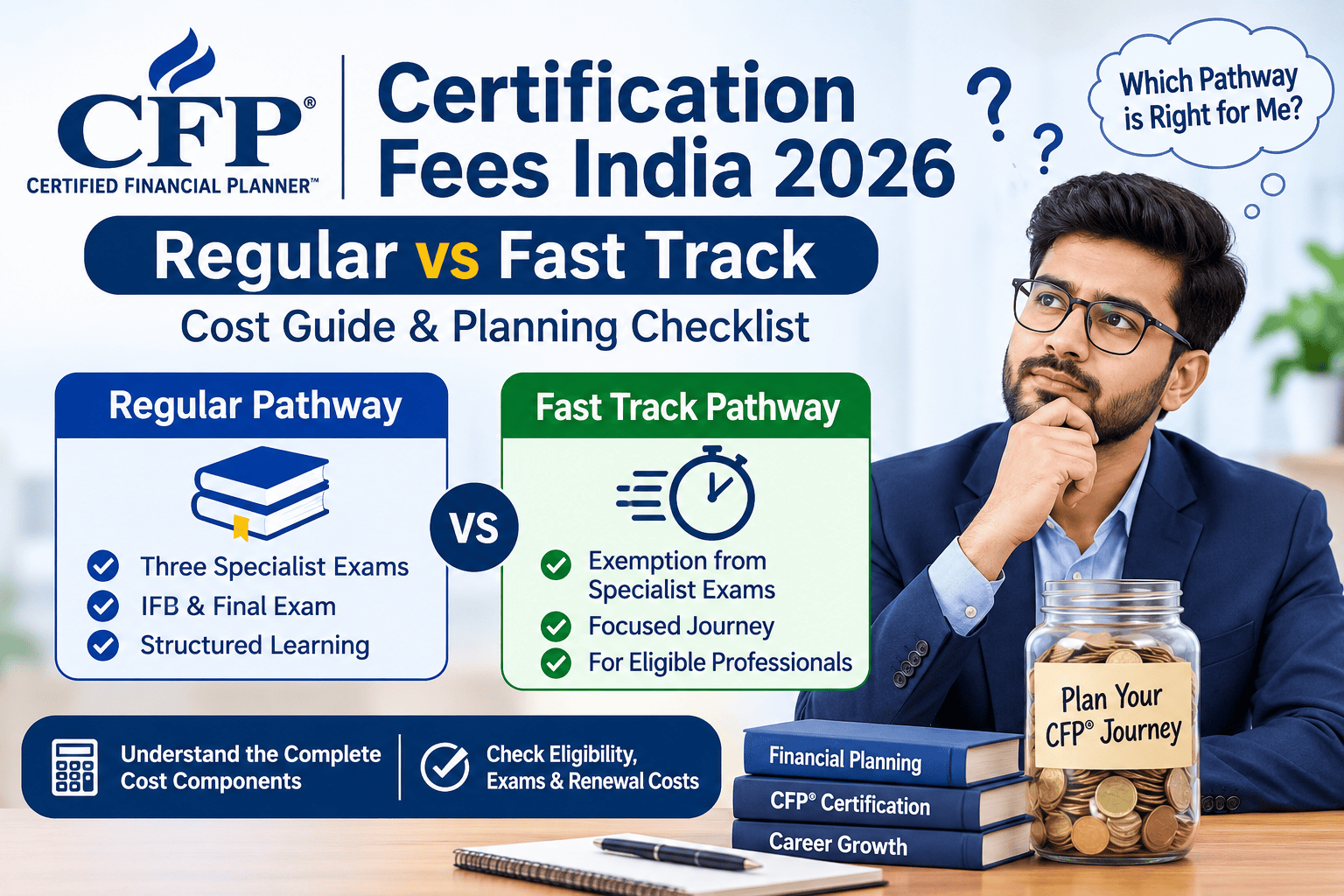
The CFP® Regular Pathway builds learning through three specialist courses before Integrated Financial Planning, the Financial Plan Assessment and the final CFP® exam. The CFP® Fast Track Pathway exempts approved candidates from specialist exams, while retaining education, ethics, the final exam and financial plan assessment requirements.
Decision factor | Regular Pathway | Fast Track Pathway |
Entry decision | Check FPSB enrollment criteria and later certification requirements. | Obtain approval against the relevant qualification and experience criteria. |
Specialist exams | Three specialist exams form part of the pathway. | Approved candidates receive exemption from specialist exams. |
Final requirements | Integrated Financial Planning, financial plan assessment, CFP® exam and ethics. | Required education, financial plan assessment, CFP® exam and ethics. |
Budget structure | Plan specialist-stage expenses and final-stage expenses separately. | Plan verification, approved registration/courseware and final-stage expenses. |
Best budgeting question | Which costs become payable at each learning stage? | Which charges remain payable after eligibility approval? |
Completion planning | Coordinate learning stages with work and exam preparation. | Coordinate document approval, education and current assessment cycles. |
Sources: FPSB India Regular and Fast Track pathway pages, checked October 6, 2026. Neither route removes the need to meet the applicable certification conditions.
For the learning structure and study options, review ICoFP’s CFP® Regular Pathway program page before choosing a preparation format.
Who should check Fast Track eligibility first?
FPSB India describes Fast Track as an accelerated route for professionals with specified qualifications and relevant financial-planning experience. Its main qualification-and-experience route requires at least three years of relevant prior experience. It also lists other eligible categories, so a job title alone is not sufficient to decide eligibility.
Prepare your qualification documents and a clear record of relevant responsibilities. If your experience spans several employers, ask which supporting documents are required. Do not assume that working in a bank or insurance company automatically establishes eligibility.
Use ICoFP’s CFP® Fast Track Pathway page as a starting point for counselling, then confirm your applicable criteria with FPSB India before paying for a pathway-dependent package.
If approval is uncertain, create a provisional budget for each route. Ask whether any payment is refundable, transferable or adjustable if your Fast Track documents are not approved. Do not presume that such arrangements are available.
Is Fast Track always cheaper than Regular?
Fewer specialist exams can change the cost structure, but they do not establish a universal saving for every candidate. Fast Track still has payable components, including verification, registration and courseware, assessment, certification and renewal. Provider tuition and included support also affect the total.
Compare equivalent scope. A quote that covers tuition only is not directly comparable with one that includes identified FPSB charges. Similarly, a lower-price package may have a different access period or mentoring allowance.
Ask for two written comparisons if you qualify for both routes: the initial amount payable and the total expected first-attempt cost. Keep retake and renewal costs outside that first-attempt total so that the comparison remains transparent.
What should your 2026 cost-planning checklist cover?
Confirm your pathway eligibility before committing to pathway-specific tuition.
Record the fee schedule date and the period for which the provider quote remains valid.
Separate FPSB charges from education-provider tuition on your worksheet.
Check whether taxes, processing charges and payment-gateway charges are included or additional.
List all mandatory learning components and ask whether each is covered.
Confirm exam and assessment charges without double-counting a bundled option.
Check the learning-platform access period and extension policy.
Request the refund, cancellation, batch-transfer and deferral terms in writing.
Ask how many mock tests and mentoring sessions the preparation package includes.
Keep a contingency line for a retake or additional support, without treating it as inevitable.
Include certification and annual renewal separately from course completion.
Check your intended exam and assessment cycles against FPSB India’s current calendar.
How can working professionals plan payment timing?
Start with your work calendar. Peak reporting periods, client meetings and travel can affect your ability to attend classes and complete a financial plan. Set a realistic preparation schedule before selecting an assessment cycle.
Use a simple worksheet with five columns: expense, recipient, amount confirmed, payment due date and inclusion status. Mark unknown amounts as “confirmation required” rather than filling them with a competitor’s price.
A hypothetical example: a relationship manager considering Fast Track first requests document review, then obtains an itemised preparation quote and checks assessment dates. A graduate who does not meet the applicable Fast Track criteria instead budgets specialist-stage learning and exams through Regular. These examples illustrate planning decisions, not guaranteed admission outcomes or completion times.
Are EMI and zero-interest options available?
ICoFP’s CFP® program page describes financing options, including a zero-interest arrangement that can involve a processing fee. Ask the admissions team to confirm current availability, lender eligibility, repayment terms and the total amount payable for your chosen package.
Zero interest does not necessarily mean zero additional cost. Read the written financing terms and ask whether third-party FPSB payments are financed or paid separately. Do not assume every charge is included in an EMI plan.
How should you assess value beyond the course price?
For a working professional, useful support is support you can actually access. Compare class timing, recording availability, question practice, feedback on case studies and guidance for financial plan preparation. ICoFP’s Regular page describes recorded live classes, while its Fast Track page describes preparation and mentoring support. Confirm the current batch inclusions before enrolling. [3][4]
You can also review ICoFP’s institutional background when evaluating an education provider. Keep that background separate from the written terms of your individual course package.
If you are still deciding whether CFP® aligns with your goals, read which wealth management certification fits your career before committing to a certification budget.
What should you do before enrolling?
Choose the pathway you are eligible for, confirm its current requirements, and request an itemised quote. ICoFP is an authorized education provider; FPSB India grants CFP® certification after candidates meet the applicable requirements. Enrolling in coaching is not the same as obtaining the credential.
To clarify eligibility, current CFP® course fees and payment options, contact ICoFP’s admissions team with your qualifications, relevant experience and preferred study schedule. Ask for the written fee breakdown before making your decision.